
A product can feel like a living thing. It’s born as a hunch, it grows through feedback, and if you’re honest, it can also outgrow its purpose.
That’s why the product management lifecycle matters. It’s the work of turning messy inputs (customer pain, sales pressure, tech limits, market shifts) into clear decisions, then repeating that loop until the product is stable, profitable, or ready to retire.
If you’re a founder, marketer, or small business owner building business ideas into real revenue, this guide breaks down the phases and the decision points that keep teams focused and costs under control.
A simple way to picture the product management lifecycle
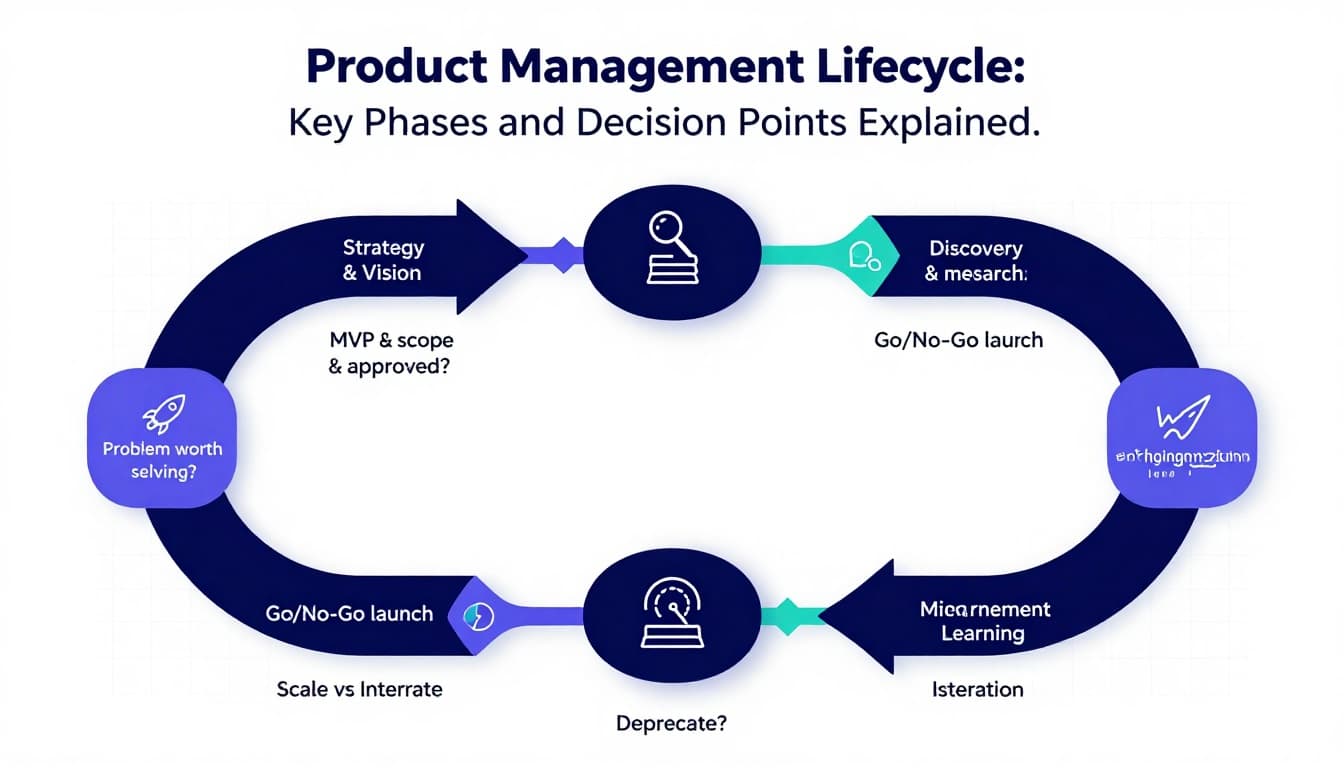
The product management lifecycle is not the same as the classic “product lifecycle” (introduction, growth, maturity, decline). That model is useful for market timing and expectations, as explained in ProductPlan’s guide to the product lifecycle and product management’s role.
The product management lifecycle is more hands-on. It’s what you do week to week to decide what to build, why to build it, and when to stop.
Phase 1: Strategy and vision (set the target)
This phase is about choices, not slogans. A clear strategy tells everyone what “winning” looks like.
Key outputs
- A sharp problem statement (who has the pain, how often, and why it matters)
- A positioning idea (what you’ll be known for, and what you won’t do)
- Success measures (retention, revenue, time saved, risk reduced)
Decision point: Is this a problem worth solving?
A good test is to ask: if you stopped working on this tomorrow, would anyone complain, or would they shrug?
Phase 2: Discovery and research (earn the right to build)
Discovery is where business ideas meet reality. You’re trying to reduce guesswork before it gets expensive.
Good discovery combines:
- Customer interviews (behavior beats opinions)
- Support tickets and call notes
- Competitive scans (what users already pay for)
- Quick prototypes (to test workflows, not pixel polish)
If you want a grounded view of the stages many teams use, compare your approach to this breakdown of the product management life cycle stages. You don’t need to copy it, but it helps you spot gaps.
Decision point: What’s the smallest proof that this can work?
For a SaaS, that might be a clickable prototype plus a waitlist conversion rate. For a physical product, it might be pre-orders or distributor interest.
Phase 3: Prioritization and roadmapping (say “no” on purpose)
Prioritization is where many products quietly fail. Not because the team can’t build, but because they keep building the wrong “next thing.”
A practical rule: prioritize by value and evidence, not volume of requests.
Common inputs that help:
- Customer impact (how painful, how frequent)
- Business impact (revenue, retention, cost to serve)
- Effort and risk (engineering complexity, compliance, dependencies)
Decision point: Do we have enough clarity to commit?
If the work still sounds like “improve onboarding,” it’s not ready. If it sounds like “reduce time-to-first-success from 30 minutes to 10 minutes by removing 2 setup steps,” you’re close.
Phase 4: Delivery and execution (build the right thing, the right way)
Execution is where your plans collide with calendars. The job here is to protect focus while staying responsive.
What strong delivery looks like:
- Clear acceptance criteria (what “done” means)
- Tight feedback loops with design and engineering
- Risk checks (security, privacy, performance)
- Scope control (a feature can be “later,” not “never”)
Money gets real here too. If you’re running lean, this is where budgeting discipline saves you. Use this step-by-step guide to creating a product development budget to avoid the classic trap of underestimating people time and “unknown work.”
Decision point: MVP scope approved, or still drifting?
If the MVP keeps growing, the launch date becomes fiction. Lock the MVP when it can deliver a single clear outcome for a defined user group.
Phase 5: Launch and go-to-market (help people adopt it)
A launch isn’t a finish line. It’s your first public test under real conditions.
What to line up before launch:
- A simple message (problem, promise, proof)
- Onboarding paths (guided start for each user type)
- Sales enablement (demo story, pricing logic, objections)
- Support readiness (known issues, escalation plan)
Even internal products need adoption. If users don’t change habits, your “new feature” is just extra code to maintain. Borrow tactics from how to speed up product adoption with five powerful strategies and adapt them to your audience.
Decision point: Go or no-go?
Don’t treat it as a vibe check. Use a short checklist: quality bar met, support ready, rollback plan available, and tracking in place.
Phase 6: Growth, measurement, and iteration (learn fast, improve faster)
After launch, teams often chase vanity numbers. Better approach: measure what proves the product is healthy.
For SaaS and subscriptions, keep a tight watch on retention and revenue quality. This guide on key SaaS metrics every product manager should track is a solid reference point.
Signals that matter
- Activation rate (do users reach first value?)
- Retention cohorts (do they come back after week 1?)
- Expansion and churn reasons (what triggers upgrades or exits?)
Decision point: Scale, iterate, or stop investing?
If retention is weak, marketing spend will only hide it. Fix the product loop first.
For another view of lifecycle framing, ICAgile’s overview of product management lifecycle stages is useful, especially if you’re building team training around common language.
Phase 7: Sunset, rebuild, or retire (the phase nobody plans for)
Every product collects clutter: edge cases, old integrations, and features that sounded smart in a roadmap meeting.
Sunsetting is part of good product management:
- Deprecate features with low use and high cost
- Migrate customers with clear deadlines and support
- Document learnings so the next product doesn’t repeat mistakes
Decision point: Is keeping this alive hurting the business?
Sometimes the best growth move is removing work, not adding it.
The decision points that keep teams aligned (quick reference)
| Lifecycle gate | The real question | Evidence to look for |
|---|---|---|
| Problem selection | Is it painful and frequent enough? | Interviews, ticket trends, revenue risk |
| Validation | Will anyone change behavior for this? | Pre-orders, pilots, prototypes, churn reasons |
| MVP scope | What’s the smallest usable solution? | Clear outcomes, acceptance criteria |
| Go-to-market | Are we ready to support real users? | QA pass, onboarding flows, support plan |
| Growth vs fix | Should we add fuel or fix the engine? | Cohort retention, activation, churn drivers |
| Sunset | Are we paying for low value? | Usage data, maintenance cost, support load |
Conclusion: Use the lifecycle to make better bets
The product management lifecycle is less about process and more about decision quality. It helps you test business ideas with discipline, spend money where learning is highest, and stop building features that don’t earn their keep.
If you adopt one habit, make it this: document each gate decision and the evidence behind it. Over time, your team gets faster, calmer, and more accurate, and product management lifecycle work starts to feel like a system, not a scramble.

Adeyemi Adetilewa leads the editorial direction at IdeasPlusBusiness.com. He has driven over 10M+ content views through strategic content marketing, with work trusted and published by platforms including HackerNoon, HuffPost, Addicted2Success, and others.