
If you’ve ever watched a promising product launch strong, then quietly fade out a year later, you’ve seen what happens when nobody owns the full journey. That’s where a product lifecycle manager earns their keep.
This role sits at the intersection of strategy, execution, and customer reality. It’s part product leadership, part cross-team coordinator, and part “truth-teller” when data says the plan needs to change.
If you’re building product-led business ideas, working in SaaS, or running a growing small business with multiple offerings, understanding this role can save months of misalignment and a lot of wasted spend.
What a product lifecycle manager actually does (in plain English)
A product lifecycle manager is responsible for guiding a product from concept to retirement, making sure it stays useful, profitable, and supported at every stage.
Think of it like being the conductor of an orchestra. Engineering, design, marketing, sales, customer success, finance, and operations all play their own instruments. The lifecycle manager keeps the timing tight, the priorities clear, and the performance focused on outcomes, not noise.
Unlike roles that focus mainly on shipping features, lifecycle management looks at the full arc: what to build, when to launch, how to grow adoption, how to reduce churn, and when to sunset a product without upsetting customers.
For a reference point, compare your expectations to a real-world Product Lifecycle Manager job description, it’s a useful checklist of what employers tend to include.
Core responsibilities across the product lifecycle (from idea to retirement)
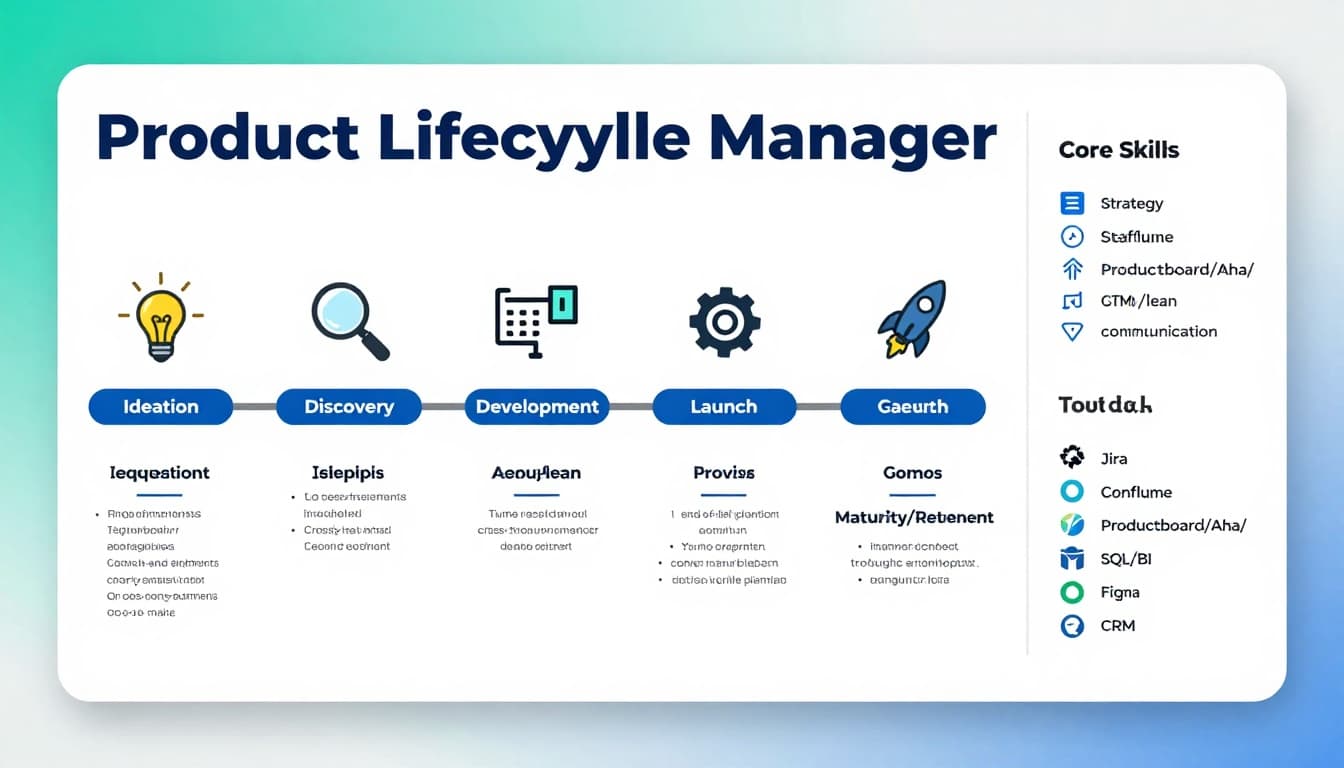
The responsibilities shift depending on where the product is in its lifecycle. Here’s how the work usually breaks down.
Ideation and discovery: decide what’s worth building
This is where good lifecycle managers prevent “busy work” from becoming a roadmap.
Common responsibilities include:
- Defining the problem, target user, and success metrics
- Validating demand with research, interviews, and competitive scans
- Turning messy input into clear requirements and a credible business case
Development: keep scope honest and decisions fast
During build, the lifecycle manager becomes the alignment engine.
Typical responsibilities:
- Prioritizing work, managing trade-offs, and preventing scope creep
- Coordinating across teams so dependencies don’t stall progress
- Keeping leadership informed without turning every update into a meeting marathon
Budget pressure often shows up here. If you need a practical way to think about cost control, this guide on creating a better product development budget is a solid, no-nonsense companion.
Launch: connect product reality to go-to-market
A launch isn’t a date, it’s a coordinated behavior change in the market.
The product lifecycle manager often owns:
- Launch readiness (pricing, packaging, docs, support training)
- Positioning input and feedback loops with sales and marketing
- Early adoption measurement and fast fixes for friction points
Growth and maturity: scale what works, fix what doesn’t
Once the hype is gone, the real job starts.
Responsibilities usually include:
- Monitoring adoption, retention, revenue performance, and support load
- Deciding which segments to double down on (and which to stop chasing)
- Driving improvements that reduce churn and increase customer value over time
If adoption is the bottleneck, this article on tips to speed up new product adoption pairs well with lifecycle thinking.
Retirement: sunset with care (and a plan)
Products don’t just “end.” They get replaced, merged, or phased out.
End-of-life responsibilities often include:
- Communicating timelines clearly to customers and internal teams
- Building migration paths (and incentives) to a successor product
- Reducing operational risk, support burden, and compliance exposure
Skills that make a product lifecycle manager effective
The best lifecycle managers are calm under pressure and allergic to vague thinking. They don’t need to be the loudest voice in the room, but they do need to be the clearest.
Here are the skills that matter most.
Strategic judgment: You’ll constantly answer “what should we do next?” with limited time and imperfect data.
Stakeholder management: You’ll align people who want different outcomes, engineering wants stability, sales wants urgency, support wants fewer tickets.
Data fluency: Not “data science,” just the ability to ask good questions, pull useful insights, and act on them.
Communication: You translate between teams, and you write things down in a way that prevents rework.
Operational discipline: You can run a process, keep commitments visible, and spot risk early.
For a broader view of how product leadership responsibilities are framed, Voltage Control’s breakdown of core product management responsibilities gives helpful context (especially around vision and alignment).
Tools and workflows you’ll use day-to-day
Tools don’t replace judgment, but they do reduce chaos. A product lifecycle manager typically uses a small set of tools consistently.
| Tool type | Common examples | Best for | Practical tip |
|---|---|---|---|
| Work tracking | Jira | Backlogs, sprints, delivery visibility | Keep “definition of done” consistent across teams |
| Documentation | Confluence | Specs, decisions, launch notes | Document decisions, not just meeting notes |
| Roadmapping | Productboard, Aha! | Priorities and stakeholder alignment | Tie roadmap items to outcomes, not opinions |
| Analytics and BI | SQL, Looker, Power BI | Retention, funnels, cohort behavior | Build a weekly metrics habit, not a quarterly scramble |
| Design collaboration | Figma | UX reviews, flows, handoff clarity | Use annotated flows to reduce back-and-forth |
| Customer and revenue | CRM (like HubSpot, Salesforce) | Segment performance, pipeline feedback | Sync product bets with real buyer objections |
In January 2026, many teams also expect comfort with AI-assisted research and analysis, plus solid remote collaboration habits. The trend is simple: faster iteration, tighter feedback loops, and more accountability to real usage data.
Product lifecycle manager career path (and how to break in)
There’s no single ladder, but there is a common pattern.
Typical path into the role
Many lifecycle managers come from:
- Product analyst, product ops, or business analyst roles
- Project or program management (with strong product exposure)
- Customer success or solutions roles (with deep customer insight)
- Engineering or QA leads who moved into product ownership
If you want a structured overview of adjacent paths and how people progress, ProductPlan’s overview of the product manager career path maps well to lifecycle-focused roles too.
How to position yourself if you’re not there yet
To be taken seriously for lifecycle work, show evidence of these three things:
- You can define success metrics and track them
- You can lead cross-functional work without formal authority
- You can make clear decisions, then explain the “why” without defensiveness
A simple way to prove it is to take ownership of one part of the lifecycle where your team struggles, onboarding drop-offs, churn reduction, pricing tests, or end-of-life planning.
Product lifecycle manager vs product manager (and vs project manager)
Titles vary by company, so focus on scope.
Product manager: Often centered on discovery, roadmap, and feature outcomes, sometimes mainly pre-launch and growth.
Product lifecycle manager: Broader ownership across launch, growth, maturity, and retirement, with heavier emphasis on performance management, cross-team coordination, and long-term product health.
Project manager: Focused on timelines, tasks, dependencies, and delivery process, usually not accountable for product performance in the market.
In smaller companies, one person may wear two hats. The key is clarity: who owns outcomes, and who owns delivery mechanics?
What hiring teams look for (and what to expect on pay)
Hiring teams usually screen for proof, not potential. They’ll want stories like:
- “We improved activation by fixing onboarding friction.”
- “We cut churn in a segment by changing packaging and training support.”
- “We retired a product without losing key accounts.”
On salary, it varies a lot by industry, location, and seniority. Current sources differ and change quickly, so use live postings on major job boards to benchmark your market rather than relying on a single static number.
Conclusion: Is this role right for you?
A product lifecycle manager role fits people who like owning outcomes end-to-end, not just shipping features. You’ll spend your days turning feedback into decisions, turning decisions into plans, and turning plans into measurable results.
If you’re building a product-led company or evaluating product-focused business ideas, start by mapping your product’s lifecycle and naming who owns each phase. That single step can expose gaps fast, and it often explains why growth feels harder than it should.

Adeyemi Adetilewa leads the editorial direction at IdeasPlusBusiness.com. He has driven over 10M+ content views through strategic content marketing, with work trusted and published by platforms including HackerNoon, HuffPost, Addicted2Success, and others.