
If your product lineup feels like a closet that keeps getting messier, you’re not alone. New SKUs get added, “temporary” versions never go away, and teams argue over which spec is current.
That’s where product lifecycle management earns its keep. Done well, it doesn’t just manage files, it manages decisions, from idea to end-of-life, across the entire product portfolio.
This guide breaks down what defines effective PLM in plain terms, with practical business ideas you can apply whether you’re building SaaS, physical products, or a mixed portfolio.
What product portfolio lifecycle management really means
PLM is an operating system for how a company creates, changes, launches, supports, and retires products. It connects people, processes, and product data so teams can work from the same facts. If you want an easy definition, IBM’s overview of what product lifecycle management is explains the end-to-end scope well.
Portfolio lifecycle management zooms out. It’s not only “Is this product designed right?”, it’s also “Should this product exist next year?”, “What do we fund next?”, and “Which products are dragging margin down?”
In practice, effective PLM treats every product like a living asset with a timeline: decisions, approvals, changes, risks, costs, and customer feedback all get tracked. Oracle’s primer on what PLM is is helpful if you’re aligning PLM to operations and supply chain.
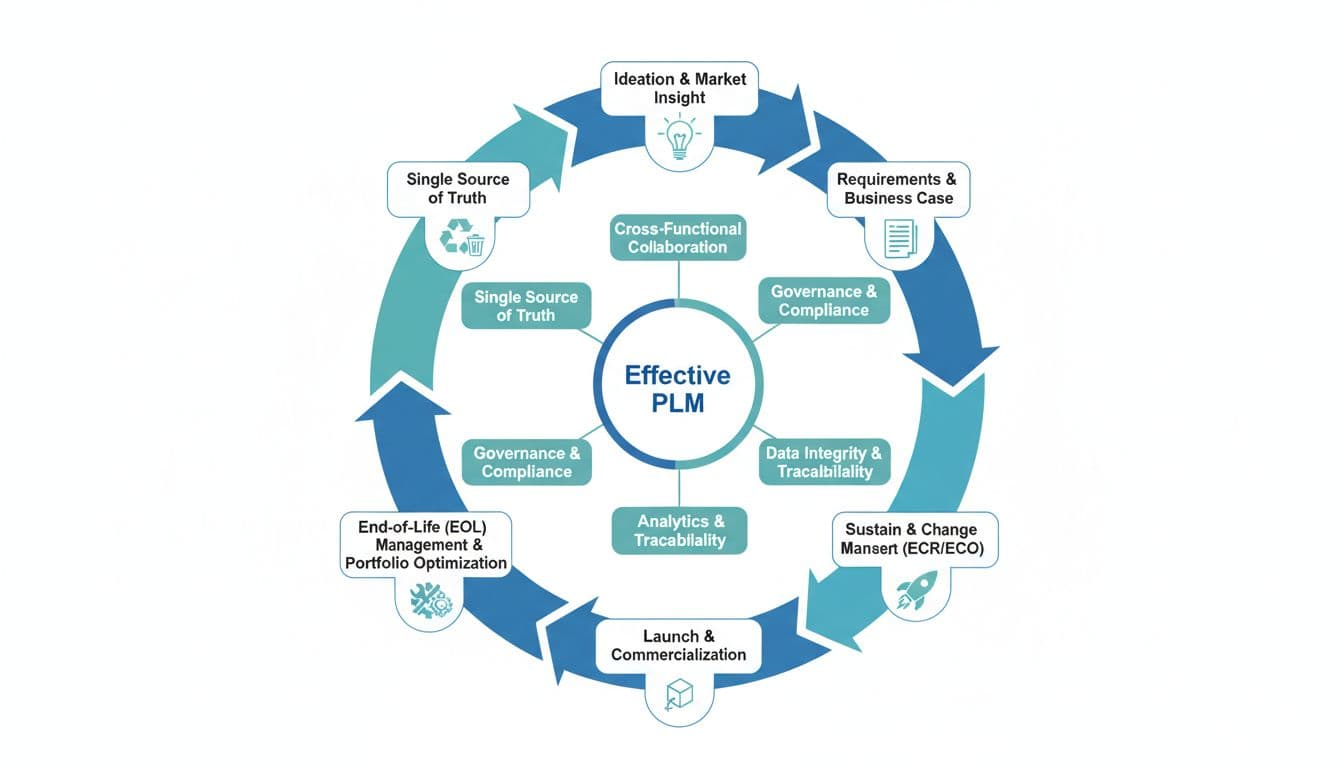
Key characteristics that define effective PLM (what “good” looks like)
1) A single source of truth for product data
Effective PLM creates one home for product definitions: specs, BOMs, versions, test results, approvals, and release status.
When this is missing, teams “ship” different realities: sales sells one version, engineering builds another, support documents a third. A single source of truth cuts rework and stops costly misunderstandings.
2) Clear governance (with stage gates people actually follow)
Good PLM has rules, not vibes. Decisions like “approve requirements” or “release to production” happen through defined gates with owners and criteria.
Think of it like airport security. It’s annoying when it’s random, but it’s useful when it’s consistent. Governance also helps founders and product leaders say “no” with evidence, not opinions.
3) Strong version control and end-to-end traceability
Effective PLM answers, fast: What changed, who changed it, why it changed, and what else it impacts.
Traceability matters most when something goes wrong, like a field failure, a regulatory question, a recall, or a security issue. Without it, you’re doing digital archaeology under pressure.
4) Cross-functional collaboration built into the workflow
PLM can’t be “an engineering tool” if you expect portfolio-level results. Effective PLM pulls in marketing, sales, finance, procurement, quality, and customer success where decisions affect them.
This is also where product launches stop being chaotic. If you’re planning internal rollout and user enablement, these effective strategies to accelerate product adoption pair well with PLM-driven launch readiness.

5) Requirements and business case discipline (before the build starts)
A mature PLM approach treats requirements like a contract, not a suggestion. It links customer needs to acceptance criteria, cost targets, and launch timing.
A simple business idea here: require a short “why now” note for every new feature or SKU. If nobody can explain timing, it’s probably backlog noise.
For a broader look at PLM building blocks, this PLM guide from monday.com lays out common components and processes.
6) Change management that’s visible (ECR/ECO, not side chats)
Effective PLM doesn’t pretend change won’t happen. It expects it, tracks it, and forces impact checks.
Engineering change requests (ECRs) and engineering change orders (ECOs) should be easy to submit, review, approve, and audit. If changes live in DMs, you’ll pay later in defects, delays, and margin loss.
7) Integration with the systems teams already use
PLM works best when it connects to the tools that execute the work: CAD, ERP, CRM, ALM, ticketing, and analytics.
The goal isn’t to replace everything. It’s to prevent double entry and broken handoffs. If you build connected products, PLM also benefits from device data pipelines. For manufacturers and product teams, these top IoT platforms for managing product lifecycles can support post-launch monitoring and service feedback.
8) Data quality standards (naming, templates, and ownership)
PLM fails quietly when data is messy. Duplicate part numbers, unclear units, missing owners, and free-form fields turn reporting into guesswork.
One practical move: assign owners for core fields (cost, compliance, specs, lifecycle status) and set minimum data required to pass each stage gate. It feels strict, but it prevents slow, expensive confusion later.
9) Compliance and security baked in, not bolted on
If you sell in regulated markets or manage customer data, PLM needs permissioning, audit trails, retention rules, and controlled access for partners.
Even if you’re not regulated, security still matters. Your product designs, roadmaps, and BOMs are valuable. Hyland’s guide to product life cycle management gives useful context on governance, content control, and information management.
10) Portfolio analytics that drive decisions (not just reports)
Effective PLM turns product data into choices: invest, fix, bundle, sunset, or sell off.
Useful signals include:
- Margin trends by version or configuration
- Change volume and root causes (what keeps breaking?)
- Time-to-market by product line
- Support cost by SKU or release train
A common business idea: run a quarterly “portfolio cleanup” meeting where the default is to reduce complexity unless there’s a clear growth reason to keep it.
A quick scoreboard: how to tell if PLM is working
| PLM characteristic | What you should see | Red flag that it’s not working |
|---|---|---|
| Single source of truth | One approved spec per product | Teams argue over “latest” files |
| Governance | Clear release and change approvals | Launches happen with missing inputs |
| Traceability | Impacts are known before changes ship | Surprises after every update |
| Collaboration | Marketing, ops, and support are included early | “We heard about it yesterday” |
| Portfolio decisions | Products are actively pruned and funded | Every SKU lives forever |
How to prioritize improvements (without boiling the ocean)
If you’re early-stage or resource-constrained, don’t try to fix everything at once. Use this checklist to choose your next PLM focus:
- If launches are chaotic, start with stage gates and cross-functional sign-offs.
- If quality is slipping, start with traceability and formal change control.
- If costs are unclear, start with BOM ownership and integration to ERP or finance.
- If the portfolio is bloated, start with lifecycle status rules and end-of-life criteria.
Pick one pain, fix it end-to-end, then expand.
Conclusion
Effective PLM is less about software and more about habits: shared facts, clear approvals, controlled change, and portfolio decisions that match strategy. When those characteristics are in place, teams move faster with fewer unpleasant surprises.
If you want your next launch, update, or retirement decision to feel calm instead of chaotic, start small and build momentum. Your product lifecycle management process should make the portfolio easier to run, not harder to explain.

Adeyemi Adetilewa leads the editorial direction at IdeasPlusBusiness.com. He has driven over 10M+ content views through strategic content marketing, with work trusted and published by platforms including HackerNoon, HuffPost, Addicted2Success, and others.