
If your SaaS product is solid but growth feels random, you don’t have a product problem. You have a saas go-to-market strategy problem.
A good GTM plan is like a flight path, it doesn’t guarantee perfect weather, but it keeps you off the mountains. It forces choices: who you serve, how you charge, where demand comes from, and what “success” looks like after the first signup.
This guide breaks the process into practical moves you can use to launch, fix a shaky launch, or scale what’s already working.
What a SaaS go-to-market strategy actually covers (and what it doesn’t)
A GTM strategy isn’t a slide deck you show investors once. It’s the operating plan for how customers discover your product, try it, buy it, and stick with it.
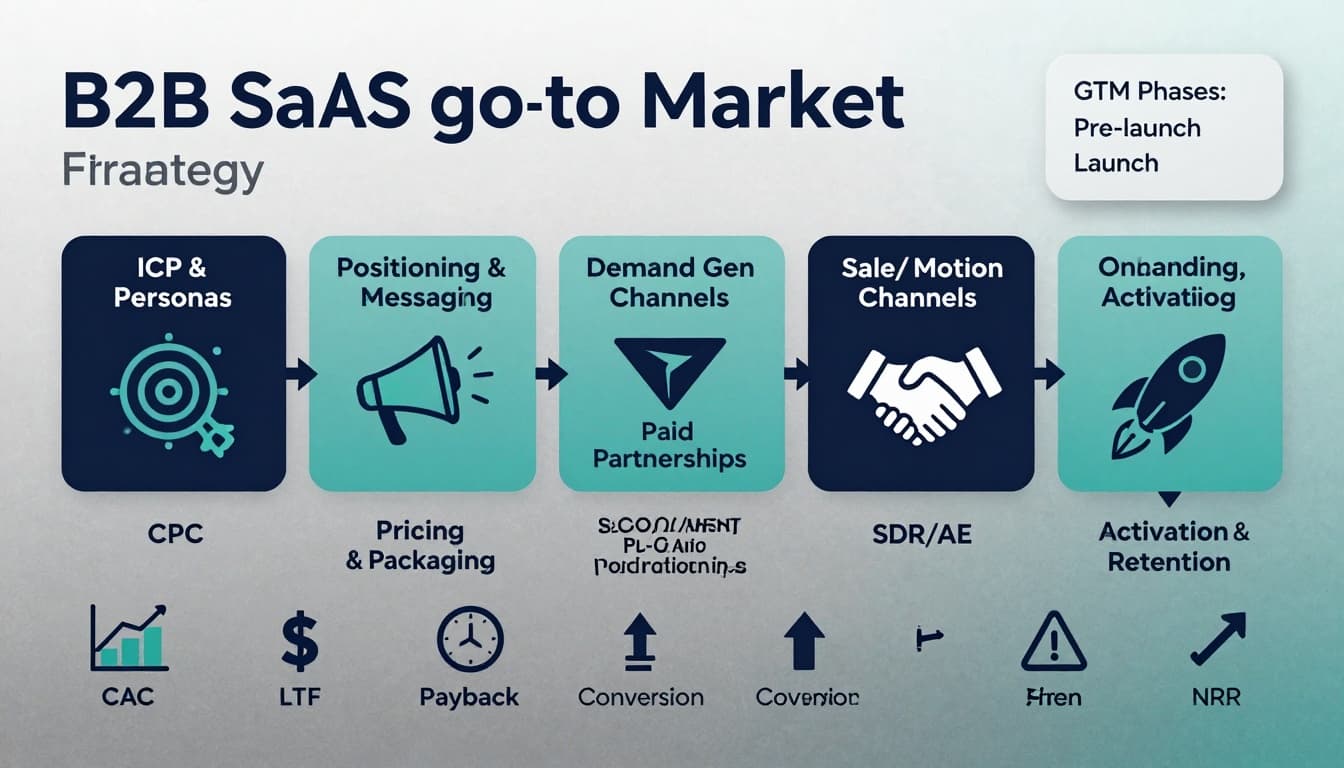
At a minimum, your GTM should answer:
- Who you’re for (ICP and personas)
- Why you (positioning and proof)
- How you charge (pricing and packaging)
- How you sell (PLG, sales-led, or hybrid)
- How you generate demand (channel mix)
- How you retain (onboarding, activation, success)
Late 2025 trends make this even more important: buyers self-educate more, AI is expected inside workflows, and niche targeting is winning because broad messaging gets ignored.
Start with an ICP you can win, not the biggest market
Most SaaS teams lose months chasing “everyone.” Your ideal customer profile is your first constraint, and it should feel a little uncomfortable because it rules people out.
A strong ICP is built on behavior, not vibes:
- They have a pain with urgency (a deadline, a cost, a risk).
- They already spend money in the category (budget exists).
- They can adopt fast (low friction, simple approvals).
- You can reach them reliably (clear channels).
Example: If you’re building an invoicing automation tool, “freelancers” is too broad. “US-based design studios with 3–15 contractors that invoice monthly retainers” is narrow enough to target, price, and message clearly.
If you want a deeper view of what to measure as leads move through your funnel, keep a short list of metrics you’ll track from day one, this guide on Top SaaS Metrics Every Founder Should Track is a useful baseline.
Positioning and messaging that earns attention in 10 seconds
Positioning is your place in the buyer’s head. Messaging is how you explain it. Both should make a reader think, “That’s me.”
A simple way to write messaging that lands:
- Problem: name the pain in plain words.
- Promise: describe the outcome, not the features.
- Proof: show credibility (data, logos, testimonials, demo video).
- Difference: say what you do that alternatives don’t.
Try this quick test: if your headline could fit any competitor’s homepage, it’s not positioning, it’s wallpaper.
For a broader GTM checklist and template-style thinking, Zendesk’s go-to-market strategy guide for 2025 is a helpful reference point.
Build the GTM foundation: ICP to retention, as one system
Pricing, packaging, and onboarding should be designed together
Pricing is not just a finance choice. It changes who buys, how fast they buy, and what support load you’ll carry.
In late 2025, more SaaS companies are testing hybrid pricing (subscription plus usage), especially for AI features where value scales with volume. That said, don’t add pricing complexity if your onboarding isn’t tight. Confusing pricing plus confusing onboarding equals churn.
Here’s a quick way to match pricing to motion:
| Offer model | Best fit | Why it works | Watch out for |
|---|---|---|---|
| Freemium | High-volume SMB | Fast adoption, word-of-mouth | Support and infra costs |
| Free trial | Mid-market SMB | Clear evaluation window | Trial-to-paid drop-offs |
| Demo-first | Enterprise | Control and security review | Longer cycles, more labor |
| Usage-based add-on | AI-heavy workflows | Aligns price to value | Bill shock if not guided |
Choose your sales motion: PLG, sales-led, or hybrid
Your sales motion is the bridge between value and revenue. Pick the wrong one and you’ll feel it immediately in CAC, cycle length, and churn.
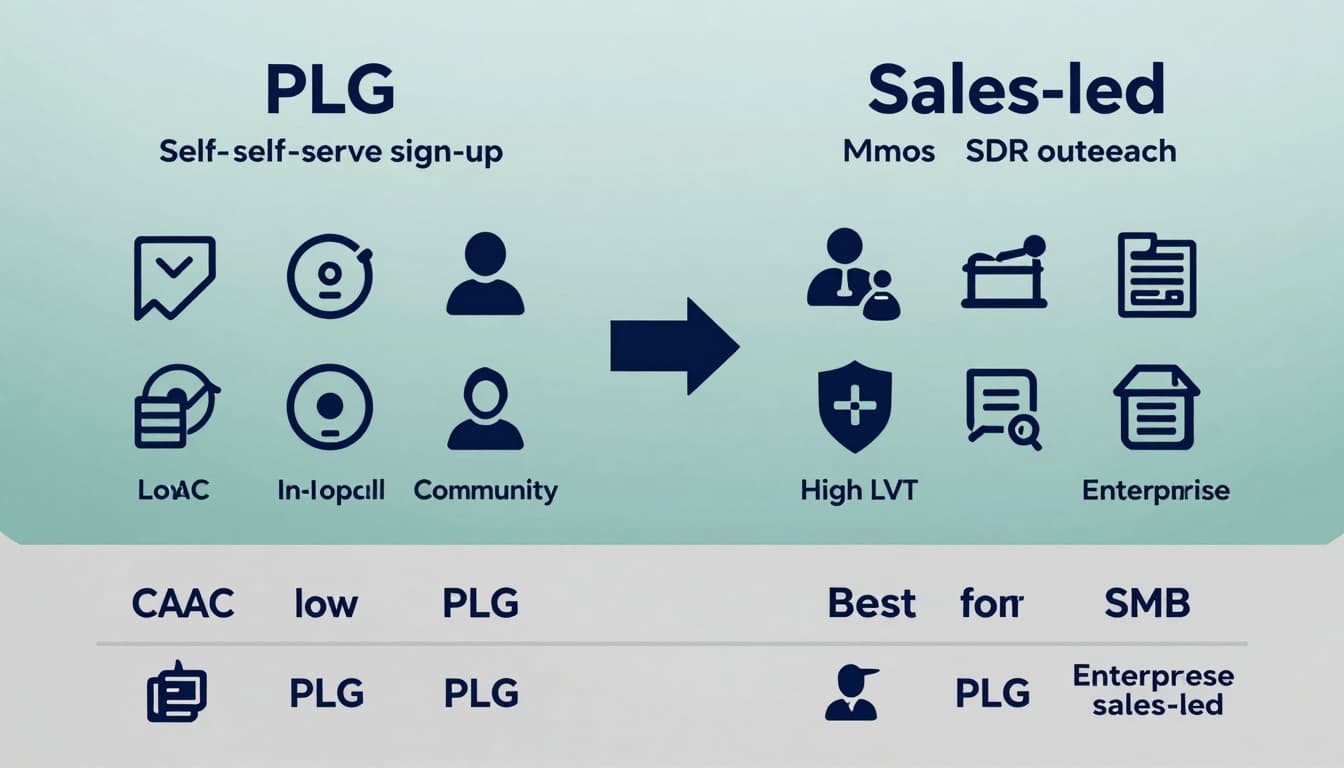
PLG works when users can reach an “aha moment” without help. Think self-serve signup, fast setup, in-app prompts, and upgrades tied to usage.
Sales-led works when value requires trust, configuration, or cross-team adoption. You’re selling risk reduction as much as features.
Hybrid is common in 2025: self-serve for small teams, sales assist when accounts hit intent signals (pricing page visits, usage spikes, stakeholder invites).
If you’re unsure, choose based on friction: the more approvals, data concerns, and customization needed, the more sales-led you become.
Build a channel mix that matches your ICP (and your patience)
Channels aren’t “best practices.” They’re bets. Make a few, measure hard, and keep what pays back.
A balanced SaaS channel mix usually includes:
SEO and content: Best for steady inbound demand, especially when buyers research before talking to sales. If you’re building content, avoid the traps in Common SaaS SEO Mistakes to Avoid.
Paid search and paid social: Great for testing messaging fast, expensive if onboarding and conversion aren’t sharp.
Partnerships and integrations: Underused and powerful. Ship the integrations your ICP already lives in, then co-market. If integrations are part of your GTM, use a checklist like Best Practices for SaaS Integration.
ABM for high-value accounts: Effective when your ICP is narrow and deal sizes justify personalized outreach.
For analytics-driven GTM planning, Amplitude’s Ultimate Guide to SaaS Go-To-Market Strategy is worth skimming for how product signals connect to revenue.
Instrument the right metrics, then build a weekly feedback loop
Your GTM doesn’t improve because you “work harder.” It improves because you learn faster than competitors.
Set up a simple weekly loop:
- Monday: review funnel and activation metrics (not just traffic).
- Midweek: listen to calls, read support tickets, scan churn reasons.
- Friday: ship one change (copy, onboarding step, pricing page test, email flow).
Focus on a tight set of numbers: activation rate, trial-to-paid conversion, CAC, payback period, churn, and net revenue retention. These tell you if GTM is healthy or just loud.
Conclusion: treat GTM like a product, not a launch event
A strong saas go-to-market strategy turns guesswork into a repeatable system: clear ICP, sharp messaging, sensible pricing, the right sales motion, and channels you can measure. Start narrow, instrument early, and keep one eye on retention because churn is the quiet killer.
If you had to fix just one thing this week, would it be your target customer, your onboarding, or your channel mix?

Adeyemi Adetilewa leads the editorial direction at IdeasPlusBusiness.com. He has driven over 10M+ content views through strategic content marketing, with work trusted and published by platforms including HackerNoon, HuffPost, Addicted2Success, and others.