
If you run more than one product (or you’re testing several product-led business ideas), you’ve probably felt the whiplash. One product needs a launch push, another is begging for new features, and a third is quietly bleeding support costs.
That’s where the product portfolio lifecycle earns its keep. It’s not just “the product lifecycle,” repeated several times. It’s the discipline of managing multiple products as a system, so today’s growth doesn’t steal from tomorrow’s pipeline, and yesterday’s winners don’t become tomorrow’s distractions.
This guide breaks down the stages, the portfolio decisions that matter most, and a simple way to run quarterly reviews without turning them into politics.
Visualize the product portfolio lifecycle as a portfolio mix
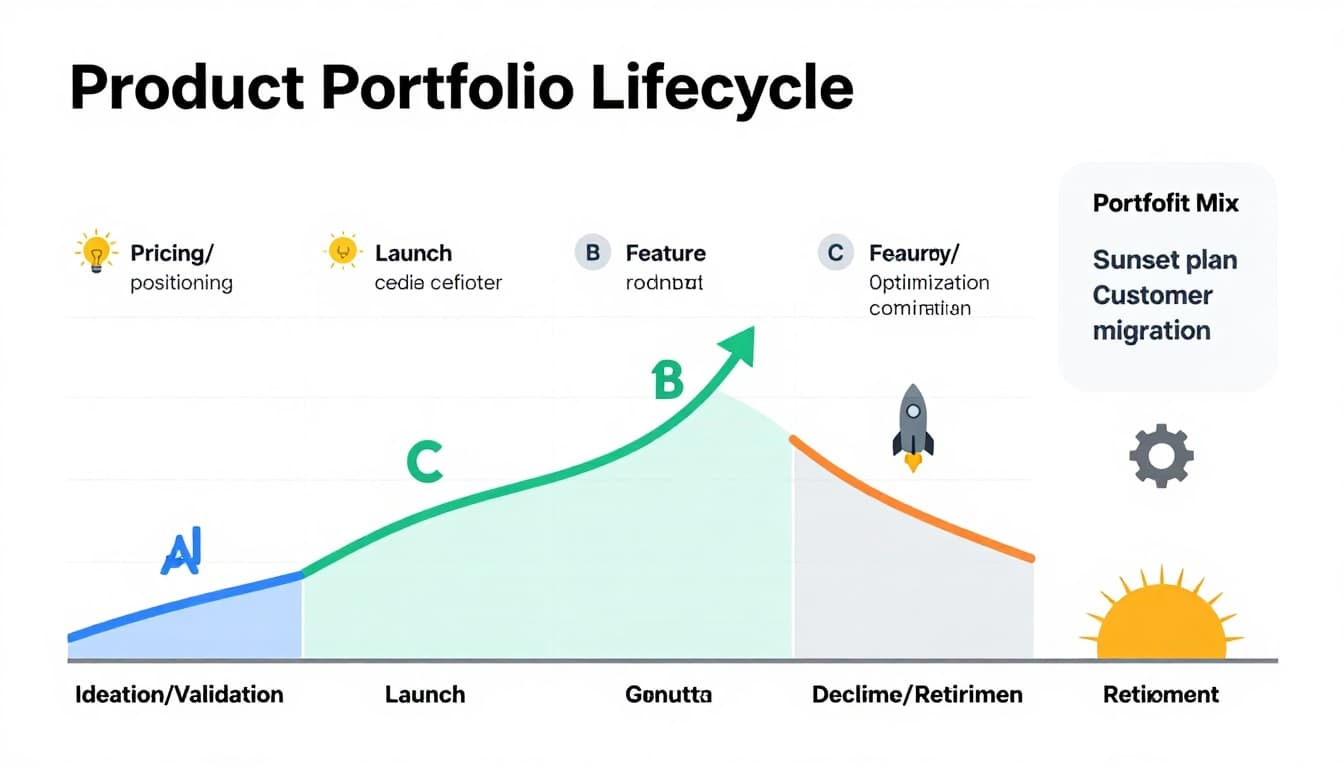
Most teams talk about “a product lifecycle” as if every product follows the same path. In real life, products behave more like a garden than a conveyor belt. Some plants grow fast and need staking, some mature slowly, and some need to be removed so the healthy ones can thrive.
A portfolio view forces you to ask better questions:
- Are we funding the next launch, or only feeding today’s top seller?
- Are we keeping too many “almost mature” products alive with support and patchwork updates?
- Do we have a plan for customer migration when a product’s time is up?
For a solid overview of lifecycle stages from a product management lens, Product School’s breakdown is a helpful reference: Product management lifecycle stages.
Build a portfolio map before you build more features
A portfolio map is a one-page snapshot of every product, its stage, and its role. If you want a quick framework for thinking in portfolios (not one-off bets), these business portfolio design strategies can help you set the right structure.
When you map your product line, include three labels per product:
1) Lifecycle stage
Ideation/validation, launch, growth, maturity/optimization, decline/retirement.
2) Portfolio role
- Core: pays the bills, protects your position.
- Growth: rising product with clear expansion path.
- Experiment: small bet, limited budget, strict learning goals.
- Legacy: still used, but no longer strategic.
3) Investment intent
Grow, maintain, harvest (maximize profit with limited spend), or sunset.
This prevents a common failure: treating every product like it deserves “growth funding.” Most don’t, and that’s okay.
Stage-by-stage decisions (what changes when you manage multiple products)
Ideation and validation: prove demand without starving the core
At portfolio level, validation is a capital allocation decision. Your goal is learning, not perfection.
Keep it tight:
- Define the customer problem and the “switch” you’re replacing.
- Time-box discovery, prototypes, and early pricing tests.
- Set a clear kill rule (for example, no traction in X weeks).
If you need to control spend, use stage gates and re-forecast often. This is where tighter budgeting helps, especially for small teams. See this practical guide on creating a better product development budget to avoid getting trapped by scope creep.
Launch: ship, position, and make adoption measurable
A launch is not a date, it’s a controlled experiment with real customers. In a portfolio, launch decisions can’t ignore opportunity cost. Every hour spent launching Product C is an hour not spent retaining Product A.
Focus on:
- A clear positioning statement and pricing logic.
- One primary channel and one backup channel.
- Activation metrics (time-to-value, onboarding completion, first key action).
If adoption is slow, don’t guess. Improve onboarding, training, and in-product prompts. These accelerating new product adoption techniques are useful when the product works but usage lags.
Growth: scale capacity, not chaos
Growth is where portfolio tension spikes. Your best product creates the loudest demands: more features, more integrations, more custom work.
Portfolio guardrails matter here:
- Protect focus with a simple roadmap rule (for example, 70 percent core improvements, 20 percent expansion bets, 10 percent experiments).
- Invest in support and reliability before fancy features.
- Watch for self-inflicted complexity across the suite (billing, permissions, reporting).
If your products share customers, growth can also mean smart bundling, tiering, or cross-sell. But be honest about cannibalization. Sometimes it’s good. It can move users to higher-margin offers.
Maturity and optimization: defend margin and reduce drag
Mature products often fund everything else, which makes teams afraid to touch them. That’s risky. Maturity is when costs creep in quietly: legacy tech debt, expanding support tickets, and sales friction.
Optimization priorities:
- Improve gross margin (hosting, support load, fulfillment).
- Simplify packaging, pricing pages, and upgrade paths.
- Reduce “long tail” features that few people use.
A mature product should feel stable, not stagnant. If you’re unsure how portfolio management tools tie into lifecycle decisions, Planview’s view on product lifecycle and product portfolio management gives useful context.
Decline and retirement: plan the exit like you planned the launch
Retirement is part of responsible product management. Customers don’t hate sunsetting, they hate surprises.
A solid sunset plan includes:
- A timeline with clear milestones (end of sale, end of support, shutoff date).
- A migration path (to a newer product, partner, or export format).
- Internal readiness (sales scripts, support macros, refund rules).
If you treat retirement as a portfolio strategy, you free resources for the next wave without burning trust.
A simple portfolio scorecard for quarterly reviews
Portfolio reviews fail when they become opinion battles. A scorecard keeps the conversation grounded.
Use a 1 to 5 score for each product:
| Scorecard area | What you’re really asking | Example signals |
|---|---|---|
| Market pull | Do customers seek this out? | inbound leads, win rate, trials-to-paid |
| Unit economics | Does it make money at scale? | gross margin, support cost per account |
| Retention health | Will it stick? | churn, expansion revenue, usage depth |
| Strategic fit | Does it support the company’s direction? | shared ICP, platform fit, cross-sell |
| Execution risk | Can we deliver reliably? | tech debt, uptime, team capacity |
Then decide one action per product: invest, maintain, harvest, or sunset. One action, not four.
How to sunset a product without damaging your brand
Sunsetting is like moving a long-time tenant out of a building you’re renovating. It’s emotional for customers, even when it makes business sense.
Keep it simple:
- Communicate early, then repeat the message in plain language.
- Offer incentives to migrate (discounts, concierge support, longer overlap).
- Track “at-risk” segments, like high-volume users or customers with integrations.
If you’re managing SaaS products, a broader overview of lifecycle process is worth bookmarking. monday.com’s 2026 guide to product lifecycle management (PLM) is a good starting point for operational workflows.
Conclusion: treat your products like a system, not a set of emergencies
A strong product portfolio lifecycle approach helps you invest with intent, launch with focus, grow without chaos, and retire products without drama. You don’t need more meetings, you need clearer decisions and a shared view of what each product is for.
Pick one step to do this week: map your products by stage and role, then score them in a 30-minute review. The portfolio will tell you what to do next, if you’re willing to listen.

Adeyemi Adetilewa leads the editorial direction at IdeasPlusBusiness.com. He has driven over 10M+ content views through strategic content marketing, with work trusted and published by platforms including HackerNoon, HuffPost, Addicted2Success, and others.