
How many contracts does your business touch in a month, and how many of them are tracked end-to-end? If your answer is “too many” and “not enough,” you’re not alone.
In large companies, contract lifecycle management is less like filing paperwork and more like running air traffic control. Requests come in from sales, procurement, HR, IT, and finance, and every missed approval or renewal date can turn into real cost, risk, or lost revenue.
This guide breaks the enterprise CLM process into clear, practical steps, with the owners, outputs, and controls that keep everything moving.
Why enterprises invest in contract lifecycle management (CLM)
Enterprises don’t struggle because they “lack contracts.” They struggle because contracts sprawl across inboxes, shared drives, spreadsheets, and vendor portals.
A strong CLM process helps you:
- Reduce risk by enforcing approved language and keeping an audit trail.
- Move faster by removing approval guesswork and repeated legal reviews.
- Improve visibility into obligations (deliverables, pricing tiers, SLAs, and penalties).
- Protect revenue by tracking renewals, uplifts, and entitlements.
If you want a vendor-neutral overview of what the CLM process looks like in practice, this CLM process diagram explanation from Icertis is a helpful reference for the typical end-to-end flow.
The contract lifecycle management process (10 steps enterprises can standardize)
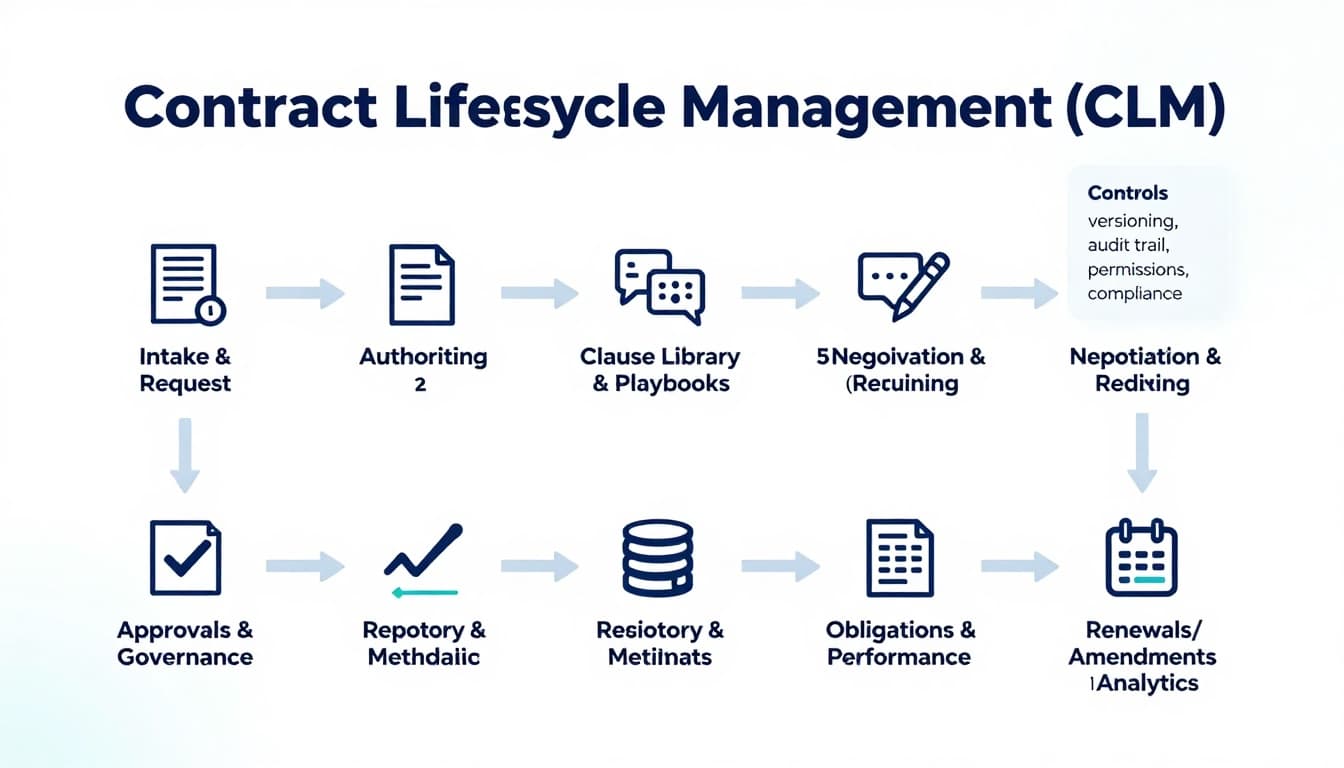
Before the step-by-step, here’s a quick view of what each stage produces and who usually owns it.
| CLM step | Primary output | Typical owner |
|---|---|---|
| Intake and request | Intake form, scope, risk flags | Requester, procurement |
| Authoring | First draft contract | Legal, sales ops, procurement |
| Clause library and playbooks | Approved fallback language | Legal, compliance |
| Review and collaboration | Comments, tracked changes | Legal, business owner |
| Negotiation and redlining | Redlined version, agreed positions | Legal, counterparty |
| Approvals and governance | Approval record, policy checks | Finance, legal, leadership |
| eSignature and execution | Signed agreement | Signatories, legal ops |
| Repository and metadata | Indexed contract record | Legal ops, procurement |
| Obligations and performance | Obligation tasks, alerts | Business owner, vendor mgmt |
| Renewals, amendments, analytics | Renewal decision, insights | Procurement, finance, legal |
1) Intake and request (start with clean inputs)
Every contract should begin with a structured request, not a random email to legal. Intake is where you capture purpose, value, term, vendor/customer details, and required dates.
Good intake prevents bad drafting. If the requester can’t explain what’s being bought or sold, the contract won’t protect the business.
2) Authoring (build from templates, not from scratch)
Contract authoring is where you generate a first draft using approved templates for NDAs, MSAs, SOWs, DPAs, partner agreements, and more.
For enterprises, the win is consistency. Templates reduce “contract personality,” where each department invents its own version and calls it standard.
3) Clause library and playbooks (your guardrails)
Clause libraries store pre-approved clauses (termination, liability caps, governing law, IP ownership, data security). Playbooks define what you can accept, what needs escalation, and what to push back on.
This is the part that turns legal knowledge into repeatable decision-making. For a quick look at how many organizations break down CLM stages, see Checkbox’s overview of CLM stages.
4) Review and collaboration (one version, one source of truth)
Collaboration is where business stakeholders and legal review the draft, add comments, and align on deal intent. The key is avoiding “version soup” (Contract_v7_FINAL_FINAL2.docx).
A solid CLM workflow keeps versioning tight and makes it obvious who changed what, and when.
5) Negotiation and redlining (control the back-and-forth)
Negotiation is where risk and economics get real. Redlines come back from the counterparty, and your team responds based on playbooks.
A practical tip: define “must-have” terms early (security requirements, data use, payment terms). Otherwise, you’ll fight about everything and agree on nothing.
6) Approvals and governance (make policy easy to follow)
Approvals should be rules-based, not relationship-based. For example:
- If liability exceeds a threshold, route to legal leadership.
- If spend crosses a budget limit, route to finance.
- If the vendor touches sensitive data, route to security.
This step protects the company and protects employees. People shouldn’t have to guess what’s allowed.
7) eSignature and execution (close cleanly)
Execution is more than “getting a signature.” It’s confirming the right entity names, signature authority, and final attachments (SOWs, pricing exhibits, DPAs).
Most teams use eSignature tools here, but the process matters more than the tool. A fast signature on the wrong terms is still a bad deal.
8) Repository and metadata (if it isn’t searchable, it doesn’t exist)
After signing, the contract needs to be stored in a searchable repository with key metadata: effective date, renewal date, counterparty, contract type, contract value, owners, and critical clauses.
This is where many enterprises drop the ball. They celebrate signing, then bury the agreement in a folder no one can find later.
9) Obligations and performance (turn words into work)
Contracts are full of “you must” statements: deliver reports, maintain insurance, meet uptime, issue credits, renew certifications, or provide notice before price changes.
Obligation tracking assigns tasks and reminders to owners. Example: a procurement manager sets an alert 90 days before a SaaS renewal so the team can review usage before the auto-renew hits.
10) Renewals, amendments, and analytics (close the loop)
Renewals are where money quietly leaks. If nobody owns renewal decisions, contracts renew by default, prices creep upward, and outdated terms stay in place.
Strong CLM makes renewal work visible by combining:
- Calendar-based alerts (30/60/90 days)
- Actual performance history
- Contract analytics (cycle time, fallback clause frequency, renewal outcomes)
For another perspective on lifecycle stages and where teams often lose control, ContractSafe’s CLM stages breakdown is a useful comparison point.
Controls enterprises should bake into every CLM workflow
You don’t need bureaucracy, you need controls that scale. Focus on a short list that prevents chaos:
- Permissions by role: requesters, reviewers, approvers, signers.
- Audit trail: who approved what, and why.
- Required fields: value, term, data type, and owner before routing.
- Policy checks: security review triggers, non-standard clause detection.
If you manage lease-heavy agreements in the public sector, accounting and compliance add another layer of control. This GASB 87 lease accounting implementation guide can help you think through documentation, classification, and reporting needs that often tie back to contract data quality.
Common enterprise CLM bottlenecks (and how to fix them)
Bottleneck 1: Legal is the only gate.
Fix: shift routine decisions to playbooks, and reserve legal time for true exceptions.
Bottleneck 2: Requests arrive too late.
Fix: set intake SLAs and require contracts before purchase orders, vendor onboarding, or sales close stages.
Bottleneck 3: Renewals have no owner.
Fix: assign renewal ownership in metadata, and make auto-renew clauses trigger mandatory reminders.
Bottleneck 4: Nobody trusts the repository.
Fix: standardize naming, require metadata at upload, and stop accepting “final” documents outside the system.
How to choose a CLM approach that fits your enterprise
Don’t start by shopping features. Start by choosing your operating model:
- Standardize first: templates, playbooks, approval rules, and intake fields.
- Integrate second: connect CLM with CRM, ERP, eSignature, and identity tools.
- Automate last: add clause suggestions, risk scoring, and extraction after your basics work.
A simple test: if your team can’t describe the lifecycle in one page, automation will magnify confusion, not fix it.
Conclusion
Enterprise contracts don’t fail because people don’t care, they fail because the process is unclear. A solid contract lifecycle management workflow gives your teams a repeatable path from request to renewal, with clear ownership and real controls.
Pick one contract type (like vendor SaaS agreements), map the 10 steps, and tighten the handoffs. Once that flow works, scaling CLM across departments stops feeling like herding cats and starts feeling like operations.

Adeyemi Adetilewa leads the editorial direction at IdeasPlusBusiness.com. He has driven over 10M+ content views through strategic content marketing, with work trusted and published by platforms including HackerNoon, HuffPost, Addicted2Success, and others.