
If compliance ops feels like a constant fire drill, your metrics might be part of the problem. Many teams track what’s easy (tickets closed, trainings assigned) instead of what’s true (how fast work moves, how accurate decisions are, and whether risk is actually covered).
A good KPI setup should work like a car dashboard. You don’t need 40 gauges. You need a few signals you trust, plus early warnings before something breaks.
This guide lays out compliance ops KPIs that show speed, quality, and risk coverage without turning into a vanity stat contest.
A simple KPI framework for compliance ops (Speed, Quality, Risk Coverage)
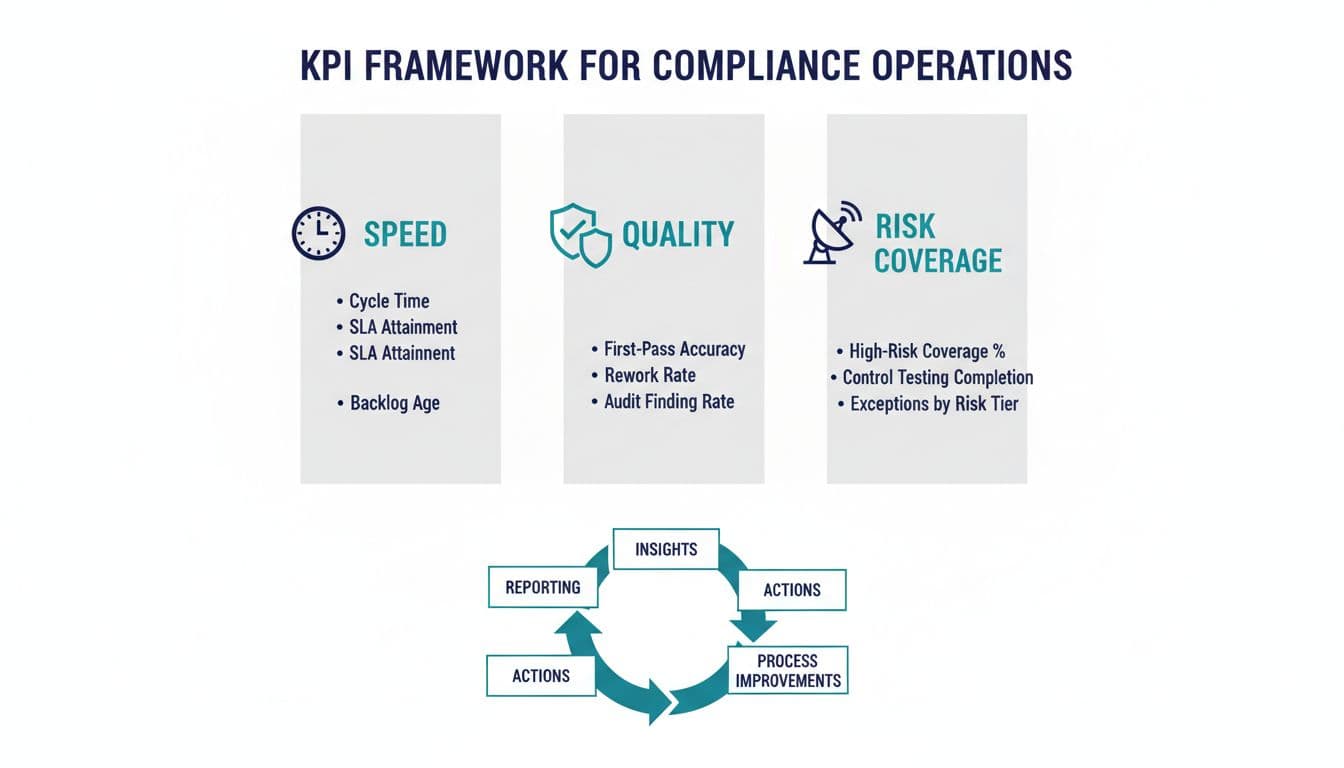
Before picking metrics, agree on the job your compliance ops team is doing. For most organizations, it’s a repeatable system that:
- moves compliance work through intake, review, decision, and evidence
- keeps errors and rework low
- proves the highest risks are covered, not just “worked on”
If you want more examples of how leaders think about compliance measurement, this overview of compliance KPIs is a helpful reference point for executive reporting.
Speed KPIs: measure flow, not busyness
Speed metrics should answer one question: are requests moving through the system fast enough to meet commitments?
The 3 speed metrics that usually matter most
1) End-to-end cycle time (median + 90th percentile)
Track the median to reflect typical work, and the 90th percentile to expose “stuck” items. Average cycle time hides pain.
2) SLA attainment rate (by request type and risk tier)
One blended SLA metric is easy to game. Split it by categories like vendor risk reviews, policy exceptions, privacy requests, SOC 2 evidence pulls.
3) Backlog age (count of items older than X days)
This is your “rotting inventory” signal. A small backlog can still be dangerous if it’s old and high-risk.
Practical example: if vendor reviews are “on time” but backlog age is rising, it often means the team is meeting SLAs by closing easy requests and postponing hard ones.
Quality KPIs: prove decisions are right the first time
Quality in compliance ops isn’t “no one complained.” It’s accuracy, consistency, and low rework under audit pressure.
Quality metrics that expose real defects
First-pass accuracy
Percentage of work accepted without rework (for example, evidence accepted by internal audit, security, or an external auditor on first submission). Define “accepted” clearly.
Rework rate (and rework time share)
Track how many items bounce back and how much time rework consumes. Rework time share is harder to ignore than rework count.
Audit finding rate tied to ops-controlled processes
Not all findings are caused by ops, so scope it. If findings linked to evidence management rise, you have a process issue, not a “people need to try harder” issue.
Decision consistency (peer variance checks)
Pick a sample of completed reviews (like vendor risk ratings) and have a second reviewer score them. High variance means your rubric is unclear.
Many GRC teams use these same ideas in broader programs, and this roundup of GRC KPIs and metrics can help you pressure-test your quality set.
Risk coverage KPIs: show what’s protected, not what’s processed
Risk coverage is where most KPI programs fail. Teams track volume because it’s simple, but regulators and buyers care about exposure.
Coverage metrics that stand up in audits
High-risk coverage percentage
Define your high-risk population (systems, vendors, processes, obligations). Then measure how much of it is currently assessed, tested, or monitored within the required interval.
Control testing completion (by control family and risk tier)
Completion alone isn’t enough, but it’s a baseline. Break it down (access control, change management, privacy, financial controls) so gaps don’t hide.
Exceptions by risk tier (open, aging, and breached)
Exceptions should exist. The KPI is whether high-risk exceptions are rare, time-bound, and actively managed.
Regulatory reporting readiness (on-time and error-free)
If your work feeds regulatory reporting, track the readiness signal: can you produce complete, consistent, reconcilable reporting on schedule? This list of KPIs for regulatory reporting is a useful checklist for what tends to break.
Analogy that fits: risk coverage is like an umbrella. Counting umbrellas tells you nothing if half your team is still in the rain.
How to avoid vanity stats (and the “KPI theater” trap)
Vanity stats aren’t always useless, but they’re often disconnected from outcomes. Common traps:
“Tickets closed” without cycle time or quality: closure volume rises when people rush or split tickets.
“Training completion” without behavior proof: it’s a checkbox, not risk reduction.
“Policies updated” without adoption: updated PDFs don’t change work.
A quick sanity check helps. Score each KPI from 0 to 2 on three questions (max score 6):
- Does it tie to a compliance outcome (audit readiness, risk reduction, customer trust)?
- Can teams act on it within 30 days?
- Is it hard to game?
Keep the KPIs that score 4 to 6. Put the rest in a “secondary signals” bucket.
KPI definitions: make them boring on purpose
A KPI you can’t define in one paragraph isn’t ready. Write a one-page KPI spec for each metric:
- unit of work (request, control test, evidence item, review)
- start and end timestamps (what counts as “start”?)
- denominator rules (what’s excluded and why)
- segmentation (request type, region, risk tier, business unit)
- owner + action (who responds when it moves)
This prevents the classic argument where dashboards become debates about definitions instead of decisions.
A dashboard-ready KPI set (copy, then tailor)
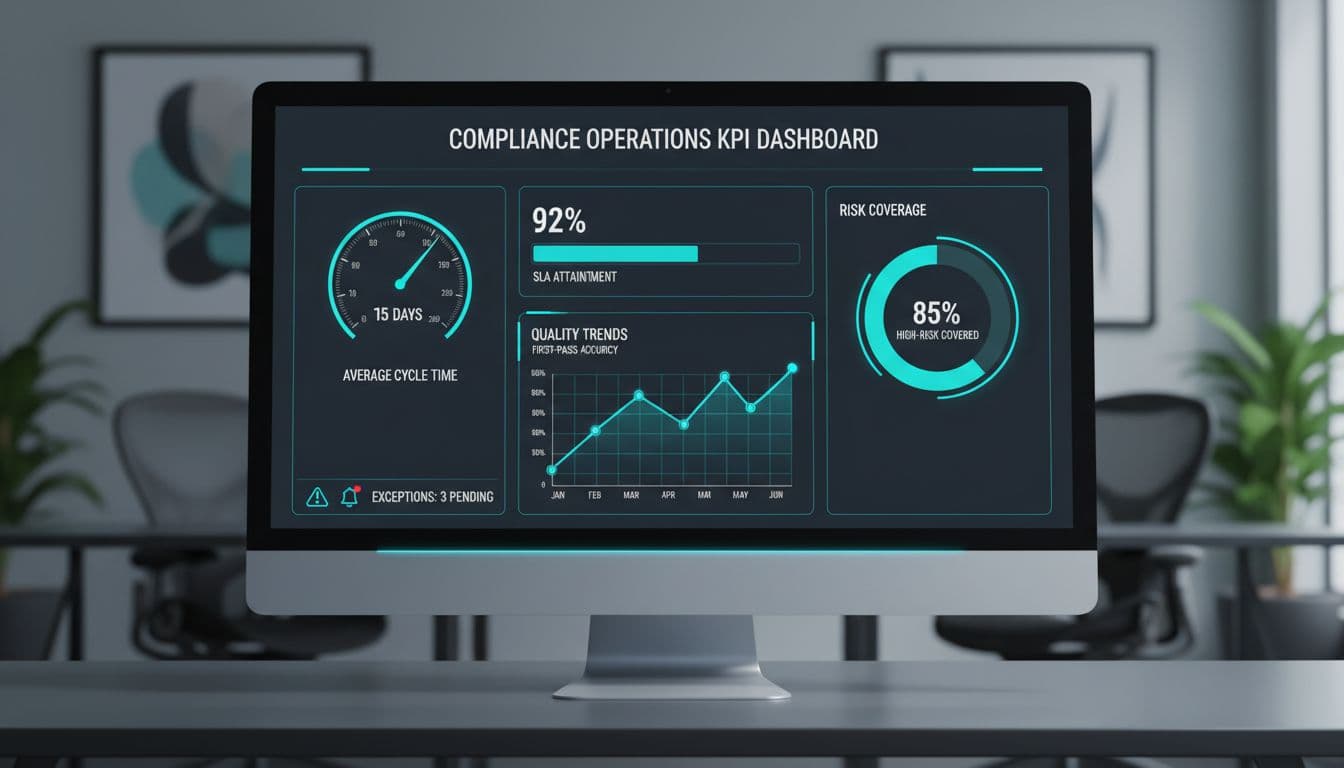
Here’s a compact set that fits on one page and still tells a full story:
| KPI | What it tells you | How to measure (simple) |
|---|---|---|
| Cycle time (median, p90) | How fast work moves, including stuck items | Created to completed timestamps |
| SLA attainment (by type/tier) | Whether commitments match capacity | % completed within SLA |
| Backlog age (over X days) | Where risk hides in “open work” | Count by aging buckets |
| First-pass accuracy | Whether outputs are accepted | % accepted without rework |
| Rework time share | How much capacity is wasted | Rework hours / total hours |
| High-risk coverage % | Whether top risk is actually covered | Assessed high-risk / total high-risk |
| Exceptions aging (high-risk) | Whether exceptions are controlled | Open days + breached count |
If you’re planning 2026 improvements now (December is usually the window), start with this set, run it for 60 days, then adjust.
Turning KPIs into action (so the numbers don’t just sit there)
KPIs only matter if they trigger behavior. A simple operating rhythm works well:
Weekly (ops level): review backlog age, p90 cycle time, SLA misses; assign owners and remove blockers.
Monthly (leadership): review quality trends and high-risk coverage; decide staffing, automation, or scope changes.
Quarterly (governance): review definitions, thresholds, and whether KPIs still reflect the risk model.
Tools that help in real teams: Jira or ServiceNow for workflow, Airtable for lightweight evidence tracking, and Power BI or Looker Studio for dashboards. For audit-readiness programs, teams often pair this with platforms like Vanta, Drata, Hyperproof, LogicGate, or OneTrust depending on scope.
Conclusion: KPI setup that earns trust
Strong compliance programs don’t win by tracking more. They win by tracking what matters, acting on it, and showing progress in plain language. When your compliance ops KPIs reflect speed, quality, and risk coverage, leadership gets clarity, auditors get evidence, and your team gets fewer surprises.
If you’re building compliance consulting or reporting business ideas alongside your core role, this KPI framework is also a solid “before and after” story you can productize. What would change in your week if you only measured seven metrics, but you trusted every one of them?

Adeyemi Adetilewa leads the editorial direction at IdeasPlusBusiness.com. He has driven over 10M+ content views through strategic content marketing, with work trusted and published by platforms including HackerNoon, HuffPost, Addicted2Success, and others.