
License renewals don’t usually fail because an operator can’t produce data. They fail because the operator can’t explain it.
When you’re renewing across multiple regulators, player data mapping becomes your evidence trail, showing where each player attribute comes from, how it changes, who can touch it, and what you reported (and why). Think of it like a set of labeled boxes in a warehouse. If every team stores items “wherever it fits,” you’ll spend renewal season opening random boxes under pressure.
This guide breaks down how to map player data across jurisdictions in a way that makes audits calmer, faster, and harder to challenge.
Why renewals get harder in multi-jurisdiction operations
Single-market renewals are tough. Multi-market renewals can feel like running the same exam in different languages, with different graders, on different dates.
A regulator may ask for proof around AML controls, responsible gaming triggers, reporting logs, or player consent handling. Another may focus on technical controls and audit trails. Your renewal risk rises when the same player event is recorded differently across products, brands, or vendors.
If you’re still building your renewal package, this UK Gambling Commission renewal guidance is a useful benchmark for how regulators think about renewals and evidence, even if you don’t operate in the UK.
What “player data mapping” means in renewals (not in theory)
Player data mapping for renewals is a working model of your data, not a diagram you dust off once a year.
It should answer, quickly:
- Where did this player identity record originate (KYC vendor, back office, affiliate landing form)?
- Which systems store the “source of truth” for balances, bonuses, limits, and exclusions?
- What transformations happen (risk scoring, segmentation, bonus eligibility)?
- What logs exist (who changed what, when, and under which approval)?
- What reporting outputs exist per jurisdiction (and how fields match regulatory definitions)?
Done well, mapping turns renewal questions into lookups instead of investigations.

Build a renewal-ready data inventory (the part most teams skip)
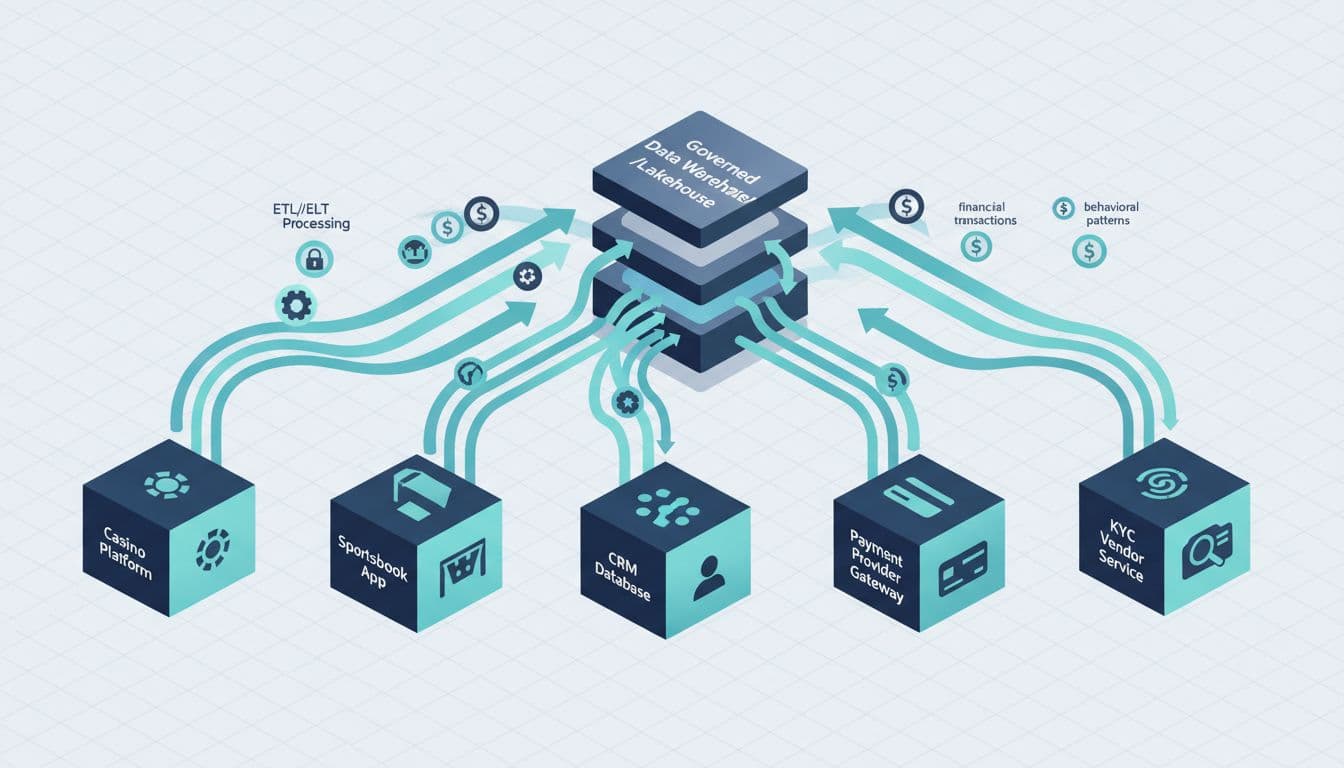
Before you map anything, you need a blunt inventory. Not “we store player data in the warehouse,” but the full set of systems that create, enrich, and export regulated data.
Start by listing your sources:
- Gaming platform events (bets, wins, session length, game history)
- Payments and wallet records (deposits, withdrawals, chargebacks)
- KYC and ID verification outcomes
- CRM and marketing events (bonuses, messaging, segmentation)
- Responsible gaming tools (limits, self-exclusions, flags, interactions)
- Fraud and AML monitoring outputs (alerts, cases, dispositions)
Then assign a business owner for each dataset. Renewals stall when “everyone owns it,” which really means no one owns it.
For deeper preparation on the documents and evidence regulators expect, keep this on hand: the iGaming compliance documentation guide (it pairs well with a data-mapping project plan).
Map lineage end-to-end (so you can defend numbers under audit)
Regulators don’t just want the number, they want the story behind the number.
Lineage shows how a field is created and changed across systems. For example, “player risk level” may begin as a rules-based score, then get adjusted by a responsible gaming analyst, then used to trigger an intervention, then exported into a jurisdiction report. If you can’t trace it, you can’t defend it.
A practical lineage map for renewals usually includes:
Source fields: exact system and event name (as implemented)
Transform rules: the logic, version, and owner (even if it’s vendor logic)
Storage layer: where the governed copy lives (warehouse, lakehouse, secure DB)
Consumption: reports, dashboards, regulator exports, and alerting pipelines
Controls: access roles, approvals, audit logs, and retention rules
A quick example (the kind auditors love)
If asked, “How do you calculate Net Deposits per player for Market A?”, your mapping should point to:
- Payment provider transaction table and event timestamps
- Refund and chargeback treatment rules
- Currency conversion method and rate source
- Cutoff timing (time zone, daily close, late-posted events)
- Exceptions (manual adjustments, failed withdrawals)
That’s the difference between “we think it’s right” and “we can prove it’s right.”
Design jurisdiction-specific controls without duplicating everything
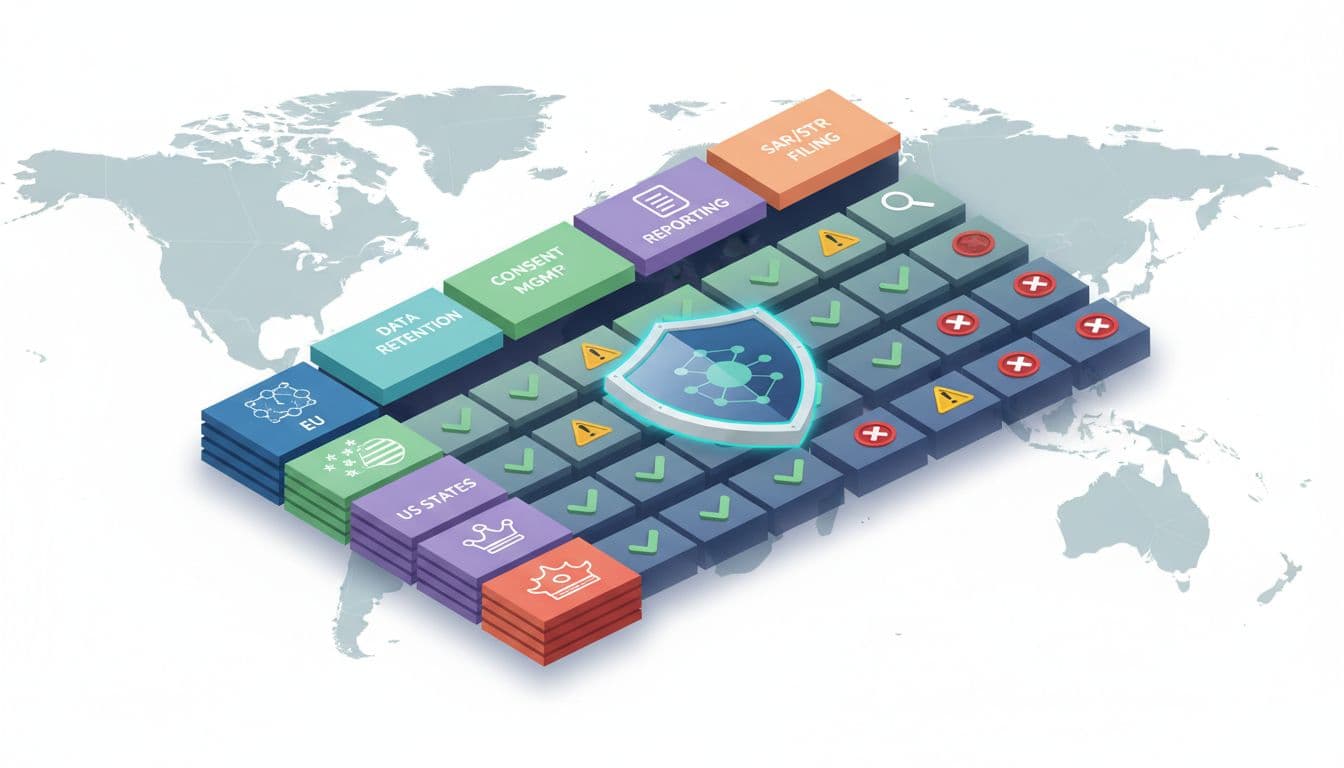
Multi-jurisdiction mapping isn’t about cloning your data stack per country. It’s about policy layers that adapt how data is stored, accessed, retained, and reported.
A simple way to structure it is a “jurisdiction control matrix” tied to your data map:
| Control area | What to define in your data map | Evidence for renewal |
|---|---|---|
| Retention | Retention period by dataset and jurisdiction | Retention schedule, deletion logs |
| Consent and privacy | Consent states, lawful basis tags, access rules | Consent records, access reviews |
| AML monitoring | Alert fields, thresholds, case workflow | Alert audit trail, SAR/STR process docs |
| Responsible gaming | Triggers, interventions, limits, exclusions | Logs of actions, escalation records |
| Audit logs | System change history and approvals | Immutable logs, change tickets |
If you’re expanding or choosing where to renew next, these jurisdiction overviews help frame the differences without overloading your team: key iGaming licensing jurisdictions and choosing a gambling jurisdiction.
Common failure points regulators and auditors notice fast
Most “data problems” are people and process problems wearing a technical costume. Watch for these:
Conflicting sources of truth: wallet balance in one system, payments in another, reports in a third.
Unexplained transformations: “the vendor calculates it,” with no documented logic or versioning.
Weak identity stitching: duplicate player profiles, weak device links, messy affiliate attribution.
Missing auditability: no clear history of changes to limits, exclusions, risk scores, or VIP status.
Inconsistent definitions: “active player,” “self-exclusion,” or “high-risk” meaning different things per product team.
If you need someone accountable for keeping this organized year-round, pair your data mapping work with a clear role scope. This iGaming compliance officer job description template is a solid starting point for defining ownership and authority.
How to turn your data map into a renewal “evidence pack”
A good data map is living documentation. A renewal evidence pack is the exportable subset that answers regulator questions without a scramble.
Aim to maintain:
- A master data dictionary for player, payments, RG, and AML fields
- Lineage diagrams for critical reporting outputs
- Access control and role definitions by dataset
- Change logs for rules that impact player treatment (bonuses, risk scoring, affordability triggers)
- A per-jurisdiction reporting index (what you submit, where it comes from, who approves it)
If your teams can produce that within hours, renewal season stops being a fire drill.
Conclusion: renewals go smoother when your data tells one story
Multi-jurisdiction renewals reward operators who can explain their operations in records, not opinions. The safest posture is simple: one governed view of the player, clear lineage, and jurisdiction controls that match how regulators assess risk.
Treat player data mapping as an operating system for compliance, not a one-time project. Your next renewal meeting should feel less like cross-examination and more like a walkthrough.

Adeyemi Adetilewa leads the editorial direction at IdeasPlusBusiness.com. He has driven over 10M+ content views through strategic content marketing, with work trusted and published by platforms including HackerNoon, HuffPost, Addicted2Success, and others.