
You can have a smart product and a real problem to solve, and still struggle to get traction. Why? Because “build it” isn’t a launch plan.
A GTM framework (go-to-market framework) is the difference between guessing and executing. It’s your route map, the same way you’d plan a road trip: where you’re going, who you’re traveling with, which roads you’ll take, and how you’ll know you’re on track.
This guide breaks down a clear GTM framework you can use for SaaS, services, ecommerce, and many other business ideas, without turning it into a 60-slide strategy deck.
What a GTM framework actually does (and who it’s for)
A GTM framework is a repeatable way to answer one core question: How will we reliably acquire customers and keep them?
It’s for:
- Startup founders who need focus before spending on product or ads
- Marketers who need a clean plan across channels, messaging, and measurement
- Small business owners who want predictable leads without wasting budget
If you want a more formal reference point, the Go-to-Market Alliance GTM framework overview is a helpful comparison to see how other teams structure their approach.
The 6-part GTM framework (simple enough to use, detailed enough to work)
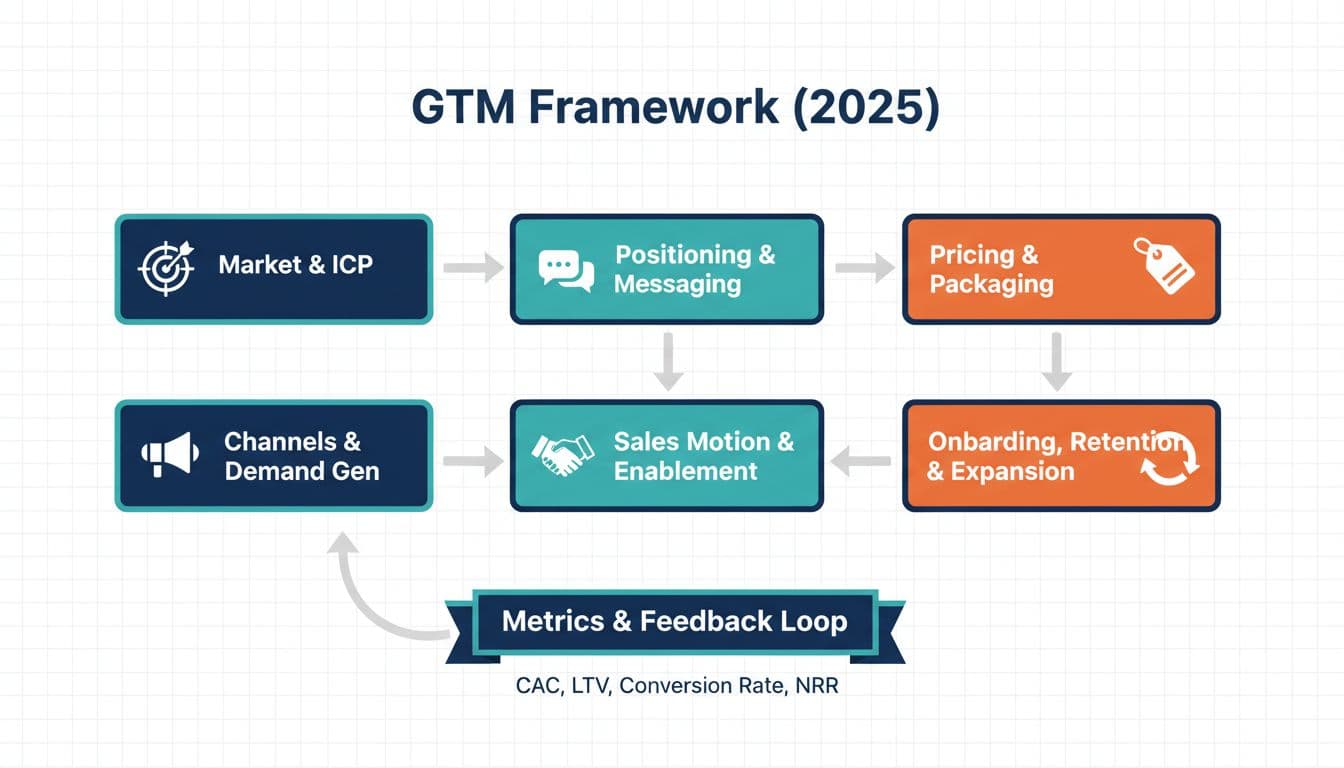
1) Market and ICP (who you’re really building for)
Your ICP (ideal customer profile) isn’t “small businesses” or “busy people.” It’s a specific buyer with a specific problem and a clear reason to act now.
A quick gut-check:
- Pain: What breaks in their day if your product doesn’t exist?
- Priority: Is this problem top-3 for them this quarter?
Example: Instead of “real estate agents,” try “solo agents closing 1 to 3 deals/month who lose leads due to slow follow-up.”
2) Positioning and messaging (why you, not them)
Positioning is your place in the buyer’s mind. Messaging is the words you use to earn attention.
Keep it concrete. Strong messaging usually includes:
- The job your buyer is trying to get done
- The “why now” trigger (new rules, new risks, rising costs, lost time)
A useful exercise is to write a 1-sentence promise your customer would repeat to a friend.
3) Pricing and packaging (how the money works)
Pricing is not just math, it’s strategy. Packaging is what you sell and what you don’t.
Start by choosing one dominant pricing logic:
- Value-based (priced on outcomes, common for B2B SaaS and services)
- Usage-based (priced on volume, common for APIs and data tools)
- Tiered bundles (priced on features and limits, common for most SaaS)
If you want extra structure, Statsig’s guide on go-to-market strategy frameworks and templates can help you see how pricing decisions connect to adoption and experimentation.
4) Channels and demand generation (how customers discover you)
Channels are just paths to attention. Pick fewer, go deeper.
A practical rule: choose one primary channel and one support channel for the first 90 days.
Examples:
- B2B service: LinkedIn outbound + referral engine
- SaaS: SEO content + product-led onboarding prompts
- Ecommerce: creator partnerships + email retention flows
The channel only works if it matches your ICP’s buying behavior.
5) Sales motion and enablement (how you close)
Not every business needs sales calls, but every business needs a closing system.
Decide your motion early:
- Self-serve: clear landing pages, fast trial-to-paid path
- Sales-assisted: demos for high intent, strong follow-up sequences
- Enterprise: longer cycles, security reviews, stakeholder mapping
Enablement can be lightweight: one page that explains who you serve, the top objections, and 3 customer stories.
6) Onboarding, retention, and expansion (how you keep and grow accounts)
A win isn’t the signup. It’s the moment the customer gets value.
Define “time-to-value” in plain terms:
- “First report created”
- “First invoice sent”
- “First 20 leads captured”
- “First automation runs without help”
Retention improves when onboarding is short, and success metrics are visible. Expansion becomes easier when you can attach new value (more seats, more usage, higher tier).
Metrics and measurement (the feedback loop most teams forget)
A GTM framework is only as good as the signal it produces. If your tracking is messy, you’ll “learn” the wrong lessons.
In late 2025, measurement is shifting toward privacy-first tracking and more server-side setups. Teams are adopting server-side tagging and consent-driven measurement to keep attribution stable even as browsers restrict cookies. That trend matters because it changes how confidently you can scale channels.
Here’s a simple scorecard you can use weekly:
| Metric | What it tells you | Healthy early signal |
|---|---|---|
| CAC | Cost to acquire a customer | Trending down as messaging improves |
| Activation rate | Users reaching first value | Up after onboarding changes |
| Conversion rate | Lead to trial, trial to paid | Improves per channel iteration |
| LTV | Total customer value | Rises with retention and expansion |
| NRR | Net revenue retention | Above 100% for strong B2B SaaS |
For a broader GTM planning template, Asana’s guide on creating a go-to-market strategy is a solid reference for turning these pieces into an execution plan.
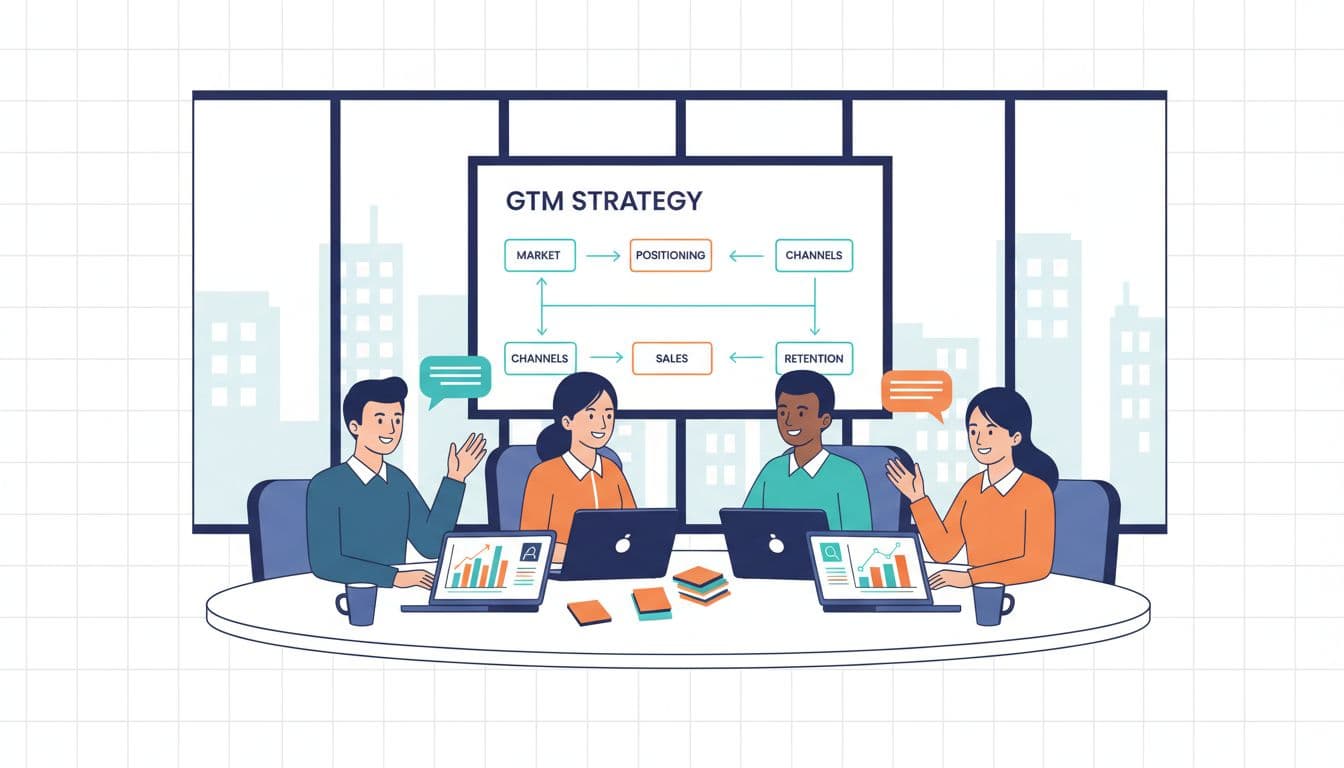
Quick examples: the same GTM framework, three different business models
SaaS business idea: AI meeting notes for sales teams
ICP: SMB sales managers, 5 to 30 reps.
Channel: SEO for “sales call notes” plus integrations marketplace.
Sales motion: self-serve with sales-assisted for teams over 10 seats.
Service business idea: bookkeeping for Shopify brands
ICP: 6-figure stores with messy payouts and taxes.
Channel: partner referrals from agencies and accountants.
Packaging: monthly tiered plans based on transaction volume.
Ecommerce business idea: premium desk accessories
ICP: remote workers buying “once, buy well” products.
Channel: creator reviews plus email flows.
Retention: post-purchase education and bundles to raise AOV.
Same framework, different answers.
Common GTM framework mistakes (and how to fix them fast)
Mistake 1: “Everyone is our customer.”
Fix: write down one role, one industry, one urgent pain.
Mistake 2: Channels before positioning.
Fix: tighten your promise first, then choose channels that fit it.
Mistake 3: Launching without a retention plan.
Fix: define activation, improve onboarding, then scale acquisition.
Mistake 4: Measuring everything, learning nothing.
Fix: pick 5 metrics, review weekly, and tie each change to a hypothesis.
How to choose the right GTM framework for your next business idea
Use this quick filter:
- If your product is simple and low price, go self-serve and optimize onboarding.
- If your buyers need trust, go sales-assisted and invest in proof (cases, reviews, demos).
- If you need volume, prioritize one scalable channel (SEO, partnerships, ads) before adding more.
The best GTM plan is the one your team can actually run every week.
Conclusion
A strong GTM framework turns a business idea into a system: clear buyers, clear message, clear channels, clear measurement. It keeps you from chasing noise, and it forces the hard choices early, when they’re cheapest to make.
Pick one ICP, one promise, one main channel, and one activation milestone, then run the loop for 30 days. What would change for your business if you did that starting this week?

Adeyemi Adetilewa leads the editorial direction at IdeasPlusBusiness.com. He has driven over 10M+ content views through strategic content marketing, with work trusted and published by platforms including HackerNoon, HuffPost, Addicted2Success, and others.