
Contracts are supposed to protect revenue, not slow it down. Yet in many small businesses, contracts live in email threads, shared drives, and someone’s memory. That’s how renewals get missed, approvals drag on, and risk slips in quietly.
Contract lifecycle management (CLM) fixes that by treating every agreement like a trackable business process, not a one-off document. If you sell services, run a SaaS company, manage vendors, or hire contractors, CLM helps you move faster with fewer surprises. It can also spark practical business ideas, like offering contract ops setup as a service or building clause templates for a niche.
What contract lifecycle management covers (in plain English)
CLM is the end-to-end system for how contracts are requested, written, negotiated, approved, signed, stored, and managed after signing.
Think of it like a relay race. If the baton (the contract) gets dropped between sales, legal, finance, and ops, your deal slows down. CLM sets clear handoffs, so the baton keeps moving.
Here’s what good CLM typically improves:
- Cycle time: fewer days stuck in review and approvals
- Risk control: less “we didn’t notice that clause” panic
- Visibility: you can find the latest version fast
- Renewals and obligations: fewer missed dates and deliverables
For a practical overview of common CLM best practices, DocuSign’s guide is a helpful reference: contract lifecycle management best practices.
The CLM process, stage by stage (and what “done” looks like)
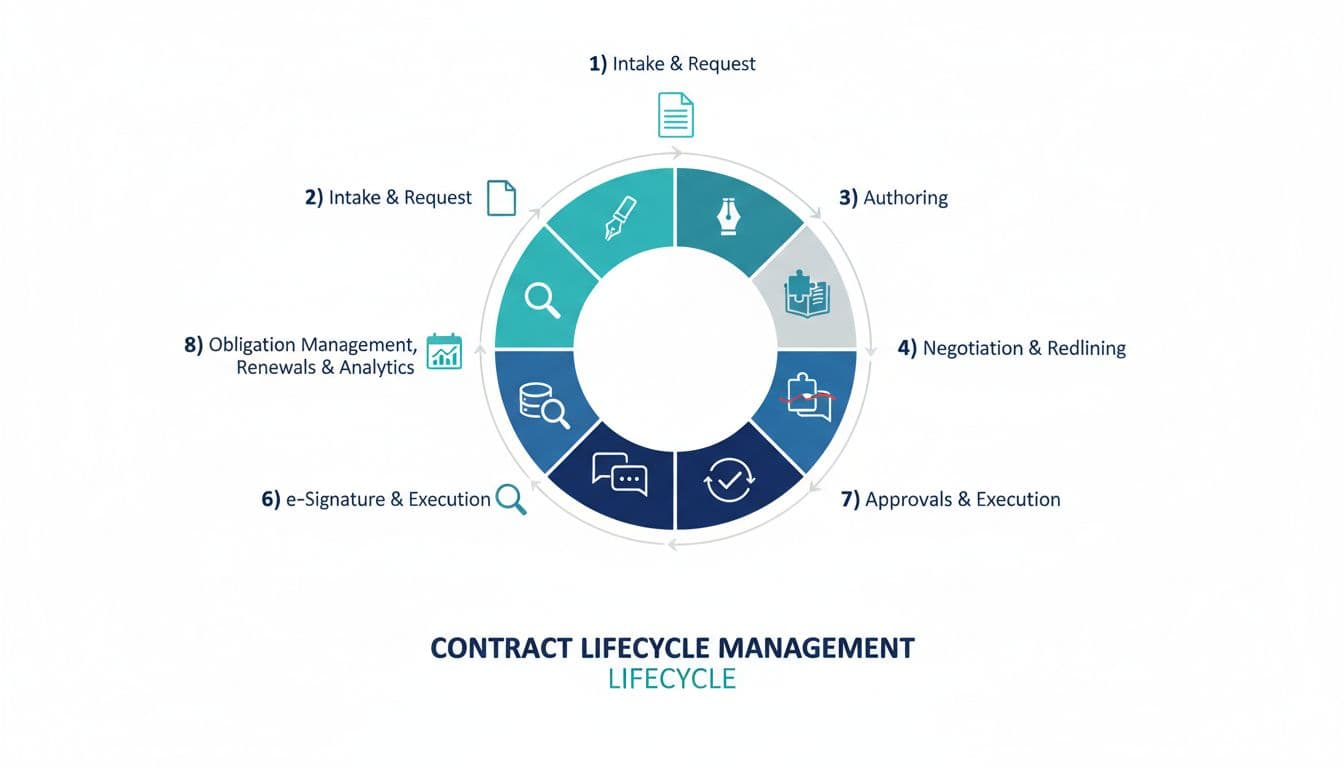
A strong CLM program follows a repeatable path. The exact names vary, but the work is the same.
1) Intake and request
This is where contract chaos often begins: “Can you review this?” with no context.
Done looks like: a simple request form that captures deal type, value, term, counterparty, and deadline, plus required attachments.
2) Authoring (draft creation)
You shouldn’t rewrite the same contract from scratch every week.
Done looks like: approved templates by contract type (MSA, SOW, NDA, vendor agreement) with standard fallback language.
3) Clause library (your reusable building blocks)
A clause library prevents “creative writing” in risky areas like liability, data privacy, and payment terms.
Done looks like: pre-approved clauses with notes on when to use them, plus fallback positions for negotiations.
4) Negotiation and redlining
Redlines are normal. Lost versions aren’t.
Done looks like: one source of truth for edits, clear ownership of changes, and a record of what changed and why.
5) Approvals and workflow
Approval bottlenecks usually come from unclear rules. Who approves a $5,000 vendor contract? What about $50,000?
Done looks like: approval paths based on triggers (amount, term length, indemnity changes, non-standard clauses).
6) eSignature and execution
Signing shouldn’t be a scavenger hunt.
Done looks like: automated routing to signers, reminders, and completed copies stored automatically.
7) Repository and search
If you can’t find it, you can’t manage it.
Done looks like: a searchable repository with metadata like renewal date, contract owner, spend or revenue impact, and key obligations.
8) Obligation management, renewals, and analytics
This is where value is won or lost after signing.
Done looks like: alerts for renewals and deliverables, plus reporting on cycle time, risk exceptions, and supplier or customer exposure.
A quick way to spot gaps is to map responsibilities. This table keeps it practical:
| CLM stage | Primary owner (typical) | Output you should expect |
|---|---|---|
| Intake | Sales, Procurement, Ops | Complete request with context |
| Authoring | Legal, Ops | Draft from approved template |
| Negotiation | Sales + Legal | Tracked edits and comments |
| Approvals | Finance, Legal, Leadership | Recorded approval decision |
| Signing | Sales Ops, Legal Ops | Executed contract copy |
| Repository | Legal Ops, RevOps | Tagged, searchable agreement |
| Post-signature | Contract owner | Renewals and obligation tracking |
CLM tools: what to look for in 2026 (without getting sold a demo)
The CLM space has shifted fast. In 2026, the big trend is practical AI and automation, not flashy features. The goal is simple: fewer manual steps, fewer missed details, better visibility.

When comparing CLM software, focus on capabilities that change day-to-day work:
- Intake workflows: guided request forms and routing
- Template and clause controls: prevent “off-template” drift
- Redlining support: versioning, comments, comparison views
- Approval automation: rules-based routing and audit trails
- eSignature integration: faster execution and fewer drop-offs
- Repository search: strong filters and metadata tagging
- AI-assisted review: clause risk flags and key-term extraction
- Integrations: CRM, procurement, billing, and storage tools
If you want a vendor-neutral way to think about best practices and outcomes, these CLM references are useful starting points: Agiloft’s CLM best practices and Wolters Kluwer’s CLM overview for legal teams.
A realistic CLM implementation plan for small teams
CLM projects fail when they aim for perfection on day one. Start with the contracts that hurt the most.
Step 1: Pick one “contract lane” to fix first
Choose one high-volume path, like sales NDAs, SaaS MSAs, or vendor agreements.
Rule of thumb: fix the lane with the most delays or the most risk.
Step 2: Standardize templates and fallback positions
Get agreement on what’s “standard,” what needs approval, and what’s not allowed.
This one step reduces negotiation time because your team stops arguing with itself.
Step 3: Define approval rules people can remember
Keep it simple. Use a small set of triggers (price, term, liability changes, unusual data terms).
Step 4: Build a clean repository with smart fields
At minimum, capture: counterparty, effective date, renewal date, notice period, owner, and contract type.
Step 5: Automate reminders for renewals and obligations
Missed renewals are expensive in two ways: lost savings and unwanted auto-renew terms.
Best practices that prevent messy contracts (and messy surprises)
A CLM system is only as good as the habits around it. These practices pay off quickly:
Keep “one source of truth.” If teams negotiate in email and store PDFs in random folders, your CLM becomes decoration.
Track exceptions, not just templates. Your “non-standard terms” list is gold. Review it quarterly and adjust templates.
Treat metadata like money. If renewal dates and notice periods aren’t captured, you’re guessing later.
Use AI carefully. AI can spot patterns and extract terms, but your team still needs clear playbooks for risk decisions.
For more tactical CLM operating ideas, Summize’s write-up on contract lifecycle management best practices is a solid checklist-style reference.
Conclusion: CLM is how you make contracts work for the business
Contracts shouldn’t feel like a black hole where deals go to slow down. With a clear process, the right tools, and a few strong habits, contract lifecycle management turns agreements into something you can measure, manage, and improve. Start small, fix one contract lane, and build from there. The payoff is faster deals, cleaner renewals, and fewer surprises hiding in the fine print.

Adeyemi Adetilewa leads the editorial direction at IdeasPlusBusiness.com. He has driven over 10M+ content views through strategic content marketing, with work trusted and published by platforms including HackerNoon, HuffPost, Addicted2Success, and others.