
A great product with a weak launch is like a solid shop on a street with no foot traffic. It can survive, but it won’t grow fast.
The best gtm strategy that works is the one that gets you learning quickly, selling simply, and improving weekly, without betting the company on a big splashy launch.
This guide is for founders, marketers, and small business owners who need a clear route from idea to revenue, whether you’re building SaaS, an agency, an ecommerce brand, or a niche service.
What “best” means in a GTM strategy (for real businesses)
The “best” GTM plan isn’t the fanciest deck. It’s the one that answers five questions clearly:
- Who are we for (and who are we not for)?
- What painful problem do we solve?
- Why should anyone trust us now?
- How will buyers discover us and buy?
- What will we measure, and what will we change next week?
In December 2025, the common thread across strong launches is simple: tighter ICPs, clearer offers, more self-serve options, smarter outbound, and faster feedback loops.
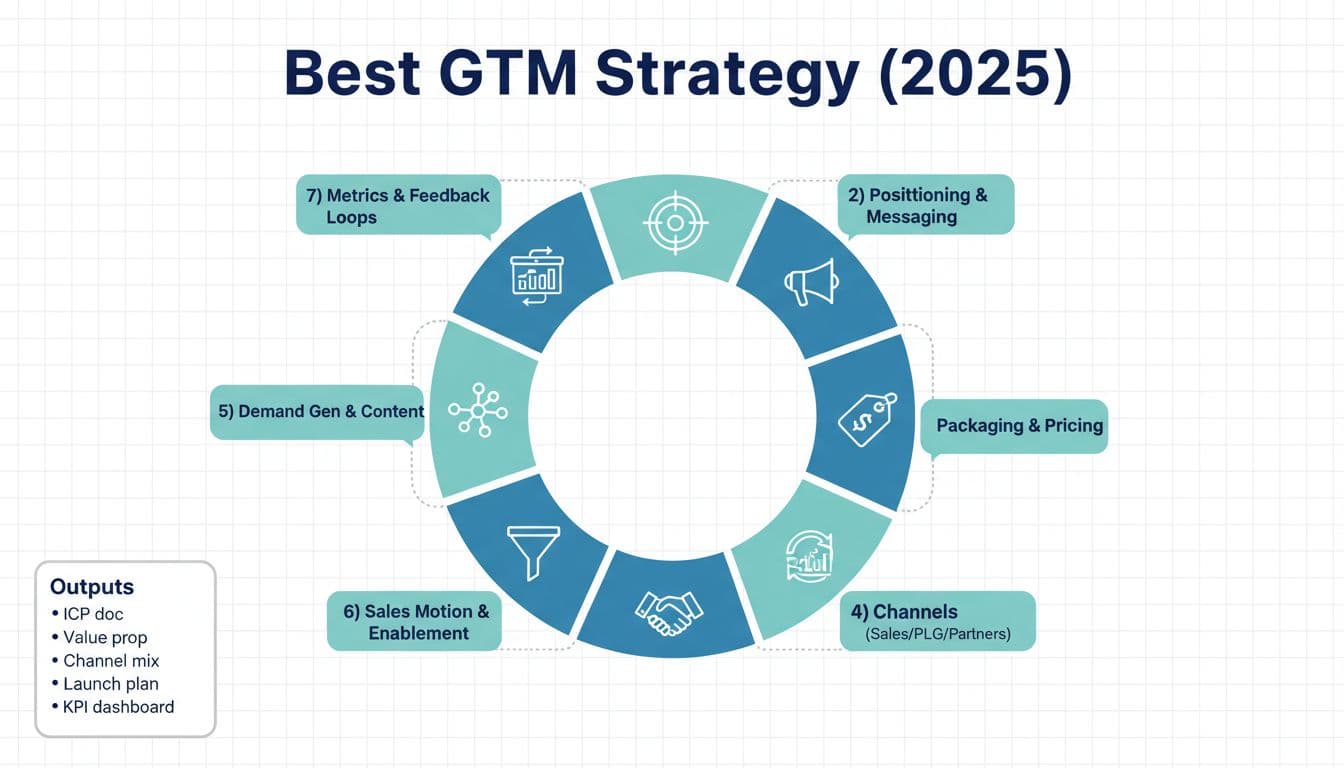
The 7-part GTM flywheel to keep you focused
Use this as your backbone, even if your business is small: market and ICP, positioning and messaging, packaging and pricing, channels, demand gen and content, sales motion and enablement, metrics and feedback loops.
If you want examples of how SaaS teams apply these pieces in practice, this roundup of SaaS GTM strategy examples is a useful reference point.
10 GTM plays you can mix and match for almost any business idea
1) ICP Interview Sprint (48 hours, not 48 days)
Summary: Do 8 to 12 short calls to learn the real buying triggers.
Why it’s valuable: faster clarity, fewer wrong features.
Who it’s for: early-stage founders, agencies, B2B services.
How to start: recruit from LinkedIn and customer forums, ask about last time they tried to fix the problem.
Tools: Calendly, Zoom, Notion.
Example: a bookkeeping service finds “month-end close panic” beats “save money.”
2) One-Sentence Positioning (with proof points)
Summary: Write a one-liner that pins your offer to a specific buyer and outcome.
Why it’s valuable: cleaner ads, better demos, stronger referrals.
Who it’s for: SaaS, ecommerce brands, consultants.
How to start: “For (ICP) who (pain), we (outcome) unlike (alternative).” Add 3 proof points.
Tools: Google Docs, customer quotes.
Example: “For clinics drowning in no-shows, we cut missed visits with SMS reminders.”
3) Pricing Ladder (good, better, best)
Summary: Package outcomes, not features, so buyers can self-select.
Why it’s valuable: higher conversion, fewer pricing fights.
Who it’s for: SaaS, retainers, productized services.
How to start: create 3 tiers with clear limits (users, volume, support). Keep a simple add-on list.
Tools: Stripe, Paddle, a one-page pricing doc.
Example: an AI content service sells “10 posts,” “30 posts,” “30 posts plus editing.”
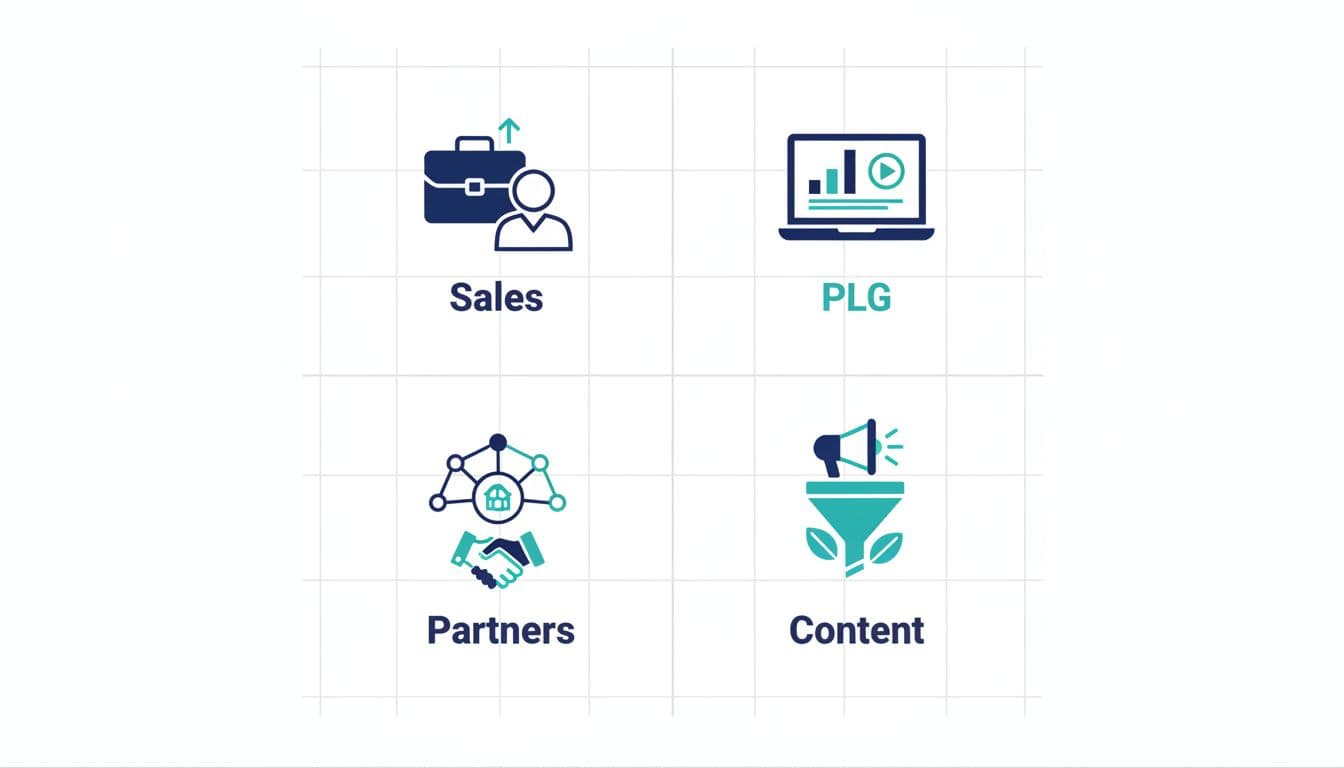
4) Channel Pick: Sales-led, PLG, Partners, or Hybrid
Summary: Choose channels based on deal size and buyer behavior.
Why it’s valuable: you stop spreading effort thin.
Who it’s for: everyone, especially small teams.
How to start: if ACV is high, start sales-led; if setup is simple, test PLG; if trust is key, add partners.
Tools: HubSpot, Pipedrive, partner lists.
Example: a cybersecurity tool uses sales-led for enterprise, PLG for startups.
5) Content Wedge (own one problem keyword)
Summary: Publish content that targets one urgent problem your ICP searches for.
Why it’s valuable: steady inbound, better conversion quality.
Who it’s for: SaaS, ecommerce, local services.
How to start: pick 10 questions from sales calls, write the best answer online, then add a template or calculator.
Tools: Ahrefs, Google Search Console, Webflow/WordPress.
Example: “RFP response checklist” becomes a lead engine for a proposal software.
6) AI-Assisted Outbound (small, personal, consistent)
Summary: Use AI to research accounts, then send human messages with one clear ask.
Why it’s valuable: faster targeting, better relevance.
Who it’s for: B2B, agencies, higher-ticket offers.
How to start: build a list of 100 accounts, write 3 short sequences, track replies and booked calls.
Tools: Apollo, Clay, Gmail, plus guidance like this go-to-market guide to AI tools.
Example: a RevOps consultant references a prospect’s job posting and offers a 15-minute teardown.
7) Community Proof Loop (build trust before the pitch)
Summary: Share useful work in public where your buyers already hang out.
Why it’s valuable: warmer leads, cheaper reach.
Who it’s for: creators, SaaS, niche ecommerce.
How to start: post 2 practical lessons a week, host one monthly live Q&A, collect stories and results.
Tools: LinkedIn, Reddit, Circle, Slack.
Example: a founder posts teardown threads and becomes the “default” expert in their niche.
8) Partner-Led Referrals (borrow credibility)
Summary: Turn adjacent businesses into a repeatable referral channel.
Why it’s valuable: trust transfers, lower CAC risk.
Who it’s for: agencies, B2B SaaS, local services.
How to start: offer a simple referral fee or co-sold bundle, build a 1-page partner kit.
Tools: PartnerStack, Google Drive, DocuSign.
Example: an HR tool partners with payroll providers serving the same SMBs.
9) Onboarding to First Value (reduce the “so what?” moment)
Summary: Design onboarding so users hit a win fast.
Why it’s valuable: better activation, lower churn.
Who it’s for: SaaS, memberships, apps, internal tools.
How to start: define “first value” in one sentence, then remove steps until it’s reachable in minutes.
Tools: Userpilot, Intercom, Loom.
Example: a CRM gets users to import contacts and send one email in the first session. (More ideas: accelerate product adoption with actionable tactics.)
10) Expansion Motion (sell the second thing early)
Summary: Plan upgrades and cross-sells from day one, not after churn shows up.
Why it’s valuable: steadier growth, stronger retention.
Who it’s for: subscription businesses and retainers.
How to start: define one expansion trigger (usage, seats, results), add a simple health score, review accounts monthly.
Tools: Stripe, HubSpot, charting dashboards.
Example: an analytics SaaS sells “team seats” once weekly active usage hits a threshold.
A simple GTM tool stack (quick comparison)
| Tool/platform | Best for | Starting cost | Key benefits |
|---|---|---|---|
| HubSpot | SMB sales + marketing | Free to paid | CRM, email, pipelines, reporting |
| Pipedrive | Sales-led teams | Paid | Simple pipeline management |
| Apollo | Outbound prospecting | Free to paid | Leads, sequences, enrichment |
| Userpilot | PLG onboarding | Paid | In-app flows, adoption tracking |
| Notion | GTM planning | Free to paid | Docs, checklists, sprint boards |
| Make | Automation | Free to paid | Connect apps, reduce manual work |
How to choose the right GTM play for your business idea
Use a quick “GTM Fit Score.” Rate each play from 0 to 2 on these five checks (10 points total):
- Speed to test (can you ship in 7 days?)
- Trust needed (high trust favors partners and proof)
- Ticket size (higher favors sales-led and outbound)
- Setup friction (lower favors PLG and self-serve)
- Repeatability (can you do it weekly?)
If you’re still shaping the business itself, this guide on key steps before launching a new business venture helps you tighten the basics before you scale a channel.
For outbound-heavy teams, it also helps to study how modern sequences are structured, this outbound playbook for 2025 is a solid reference.
Conclusion: the best GTM strategy is the one you can run weekly
The best GTM strategy isn’t a one-time launch plan, it’s a weekly system for learning what buyers want and turning that into revenue.
Pick two plays, set a 30-day goal, and track a small set of metrics you’ll actually act on. When your messaging, channels, and onboarding all point to the same promise, your business ideas stop feeling like guesses and start behaving like a pipeline. Build the loop, then keep the loop running.

Adeyemi Adetilewa leads the editorial direction at IdeasPlusBusiness.com. He has driven over 10M+ content views through strategic content marketing, with work trusted and published by platforms including HackerNoon, HuffPost, Addicted2Success, and others.