
When your iGaming platform starts pushing serious volume, sanctions screening iGaming can feel like trying to check IDs at a stadium gate using a flashlight. You can’t slow the crowd, but you also can’t wave everyone through.
The good news is you don’t need a heavy, enterprise setup to be effective. You need a focused design that screens at the right moments, handles burst traffic, keeps an audit trail, and doesn’t drown your team in false positives.
This practical guide walks through a lightweight sanctions screening setup for high-volume players, with a clear architecture, sensible matching rules, and performance tactics you can actually run in production.
What “lightweight” sanctions screening really means (and what it doesn’t)
Lightweight doesn’t mean careless. It means you pick controls that give you strong coverage with less overhead.
A lightweight setup usually aims for:
- Event-based screening (screen on key actions, not constantly)
- Fast matching with risk scoring and smart thresholds
- Queue-based exceptions so humans only see the cases that matter
- Simple evidence (logs you can hand to an auditor without panic)
It’s still anchored in the basics: you screen players against relevant sanctions lists and you can show how decisions were made. If you need a deeper regulatory refresher, this overview of AML and sanctions compliance in iGaming is a helpful starting point.
Sanctions screening iGaming architecture for high-volume traffic
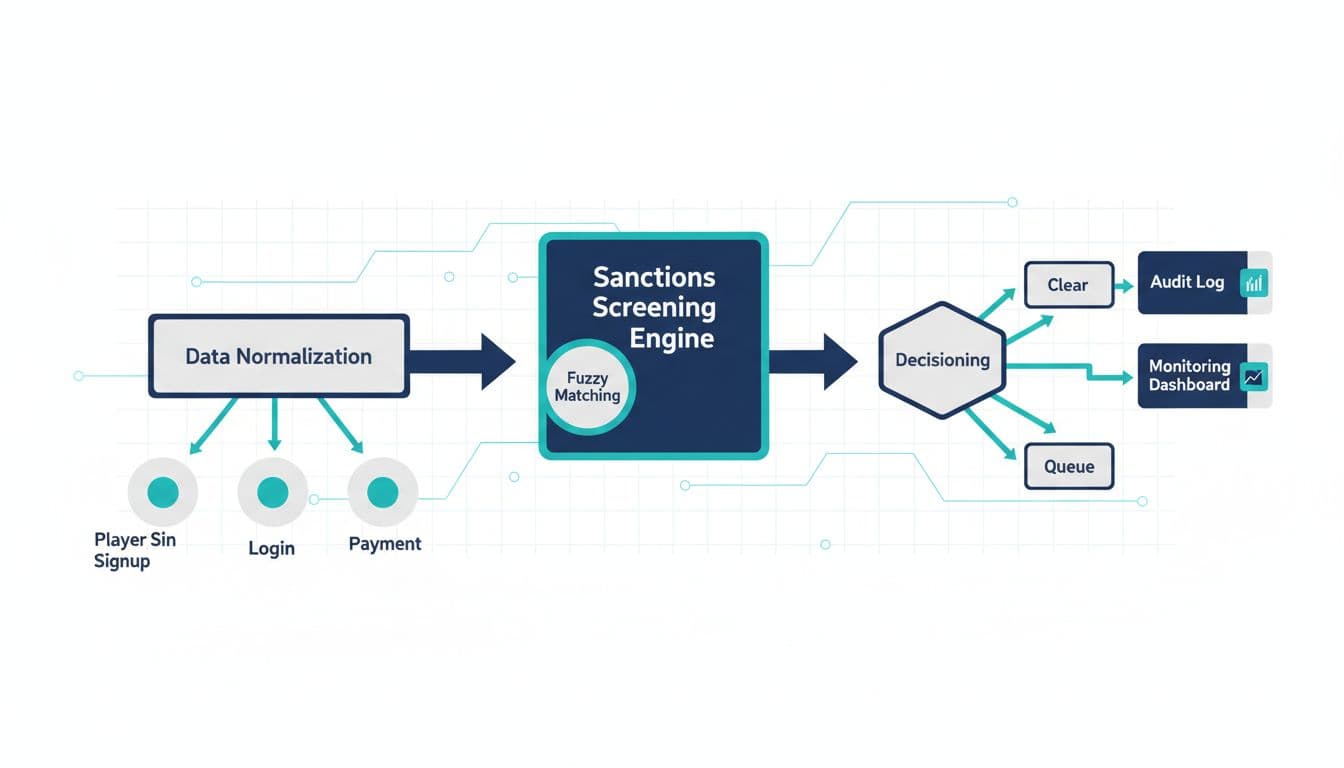
High volume is a systems problem before it’s a compliance problem. If the screening service is slow, everything else slows down: registration, deposits, withdrawals, even VIP support workflows.
A practical architecture looks like this:
1) Trigger screening on “compliance moments”
Instead of screening on every click, pick moments where identity and funds movement matter:
- Account registration (or first login)
- First deposit
- Withdrawal request
- Material profile changes (name, address, country)
- High-risk behavior triggers (your own risk engine flags it)
2) Use an event pipeline, not direct calls everywhere
Send player events to a queue, then process them in a screening service. This keeps your core product stable even during traffic spikes.
You’re building a “bouncer line” outside the club, not stopping the music inside.
3) Store decisions and evidence once
Every screen should produce a record: inputs, list version, match score, decision, reviewer notes (if any), and timestamps. That record becomes your audit trail and your internal proof when disputes happen.
For more context on gaming-specific sanctions expectations, this guide on navigating sanctions compliance in the gaming industry adds useful framing.
Data normalization: the quiet step that prevents chaos
Most screening pain comes from messy player data. A lightweight system wins by making normalization non-negotiable.
Keep a small “screening profile” per player:
- Full name (split into given and family where possible)
- Date of birth (if collected)
- Country and address fields (structured)
- Nationality (if collected)
- Known aliases (if your KYC vendor provides them)
Two practical rules that reduce noise fast:
Canonical formatting: strip extra spaces, normalize case, remove non-essential punctuation, and standardize common name particles (without overcorrecting).
Stable identifiers: keep an internal player ID and a screening profile version. When data changes, you can prove what you knew at the time of a decision.
If your KYC program is broader than sanctions, pair this with a tighter onboarding review. This iGaming KYC workflow audit guide is a solid companion piece for getting your end-to-end checks regulator-ready.
Matching and risk scoring that won’t flood your team
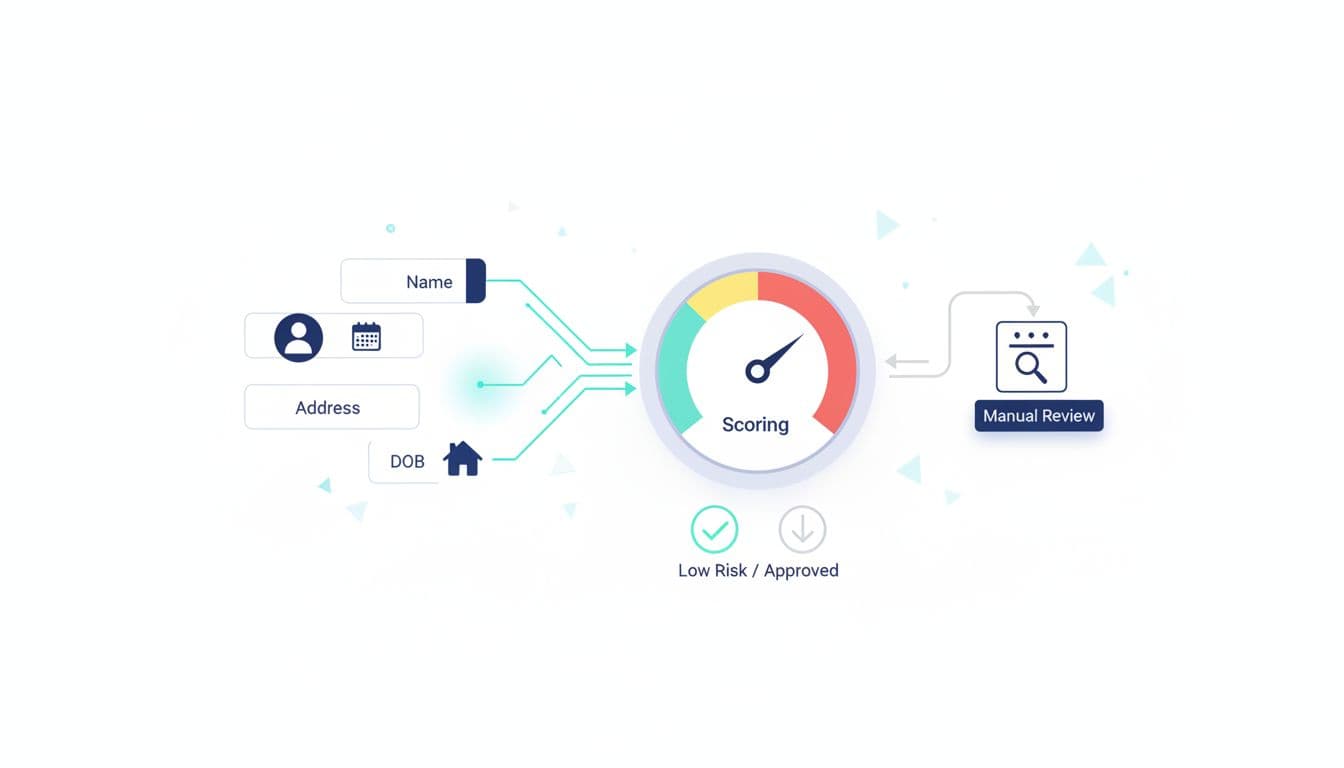
In sanctions work, the trade-off is simple: tighter matching catches more risk but creates more false hits. High-volume iGaming needs a scoring model that’s strict where it counts.
A practical approach is weighted field scoring:
- Name similarity (highest weight)
- Date of birth match (very high weight when present)
- Country or address alignment (medium weight)
- Secondary attributes (lower weight, use carefully)
Then set three decision bands:
- Clear: low score, auto-approve
- Queue: medium score, route to review
- Block or hold: high score, stop action until resolved
One tip that helps a lot: treat missing DOB as a reason to be cautious, but not a reason to block by default. Instead, push borderline cases into the review queue and ask for the next best evidence (KYC doc, verified DOB, proof of address).
If you want more detail on reducing false positives in gaming onboarding, this overview of AML in the gaming industry offers useful operational angles.
Performance tactics: how to screen fast without cutting corners

High-volume iGaming traffic is “bursty.” A tournament starts, a promo drops, payday hits, and your screening load jumps.
These tactics keep the system responsive:
Batch where it’s safe: if you’re screening many signups at once, batch list lookups and run them in parallel workers.
Cache list data smartly: keep sanctions lists in memory or a fast store, refresh on a schedule, and track the list version used per decision.
Use incremental updates: don’t rebuild everything when a list updates. Pull deltas when your provider supports it, and store changes with timestamps.
Separate real-time from backfill: real-time decisions handle player actions. A backfill job can re-screen subsets (like high-value players) after a list update without blocking gameplay.
The operational layer: queue management, SLAs, and audit-ready evidence
A lightweight setup still needs “adult supervision.” If you don’t define how review works, your queue becomes a junk drawer.
Keep it simple:
- Set a review SLA by risk tier (VIP withdrawals should not wait behind low-value signups).
- Require case notes for every override (why it cleared, what was checked).
- Track a few KPIs: hit rate, false positives, time-to-decision, and backlog.
Also, decide in advance what happens on uncertainty. For example, you might allow gameplay but hold withdrawals until review for certain score ranges. That’s a business decision, but you should document it and apply it consistently.
Build vs buy: choosing the lightest path that still works
Some operators build screening in-house; others integrate a vendor. The “right” option depends on your team, licensing scope, and expected volume.
| Approach | Best for | Starting cost | Key benefits |
|---|---|---|---|
| Vendor API integration | Small teams, fast launch | Medium | Faster setup, maintained lists, support for audits |
| Hybrid (vendor lists + your scoring/queue) | Scaling operators | Medium to high | More control on false positives and player experience |
| Fully in-house | Large operators with compliance engineering | High | Custom logic, deep tuning, internal data control |
If you’re running lean, a hybrid often gives the best balance: let a provider handle list sourcing and updates, while you own scoring thresholds and operational workflows.
A practical rollout checklist you can run this quarter
Before you ship, sanity-check the setup:
- Confirm which sanctions lists you must screen against in each market.
- Define screening triggers (signup, deposit, withdrawal, profile change).
- Normalize player data into a consistent screening profile.
- Implement scoring bands (clear, queue, hold) and document them.
- Build an analyst queue with notes, timestamps, and decision history.
- Log list version, match inputs, and outputs for every decision.
- Load test with burst traffic patterns from real promo days.
- Run weekly sampling to tune thresholds and cut false positives.
Conclusion: keep sanctions screening fast, provable, and calm
High-volume iGaming doesn’t need a bloated compliance stack. It needs a focused system that screens at the right moments, scores matches sensibly, and records decisions like you expect to be audited tomorrow. Done right, sanctions screening iGaming becomes part of your platform’s reliability, not a bottleneck your team fears.
If you had to pick just one improvement to start with this week, make it this: tighten your data normalization and decision logging. Everything else gets easier after that.

Adeyemi Adetilewa leads the editorial direction at IdeasPlusBusiness.com. He has driven over 10M+ content views through strategic content marketing, with work trusted and published by platforms including HackerNoon, HuffPost, Addicted2Success, and others.