
Meta description: A practical guide to a bonus wagering compliance audit, including scoping, evidence, system testing, and remediation steps iGaming operators can follow when regulators or partners review bonus rules.
If your bonus program is under review, it can feel like someone’s inspecting the engine while the car is still moving. Marketing wants speed, finance wants certainty, and compliance wants proof.
A bonus wagering compliance audit is that proof. It answers a simple question with uncomfortable detail: do your published bonus terms match what your systems actually do, for every player, every time?
This guide is written for operators, founders, and ops leads who need a clear plan, not vague advice. You’ll get a practical, regulator-ready set of steps and a few “business ideas” you can turn into repeatable controls.
What auditors really test in bonus wagering (and why it’s tricky)
Bonus wagering is where policy meets math. One small mismatch can trigger player complaints, remediation costs, or regulator attention.
In most reviews, auditors focus on four areas:
- Fairness and transparency: Are terms clear, consistent, and applied as written?
- System enforcement: Do platform rules enforce eligibility, contribution, caps, and expiry correctly?
- Record-keeping: Can you reconstruct what happened for a specific player and bonus?
- Connected controls: Do AML, KYC, and safer gambling triggers interact properly with bonus activity?
If you operate in regulated markets, use official guidance as guardrails. For example, Ontario operators often reference the AGCO Internet Gaming Go-Live Compliance Guide to understand the kind of evidence and operational readiness reviewers expect.
Bonus wagering compliance audit: the operator’s 10-step workflow

1) Lock the scope before you pull data
Summary: Define which bonuses, brands, markets, and dates are in review.
Why it matters: Scope creep kills timelines and creates missed evidence.
Who it’s for: Multi-brand operators and anyone with fast promo cycles.
How to start: Freeze a bonus list, versions of terms, and system configuration snapshots.
Example: Include only “welcome bonus v3” offered between Oct 1 and Dec 31 in Market A.
2) Build a “source of truth” for bonus terms
Summary: Prove what players were promised at the time of offer.
Why it’s valuable: Audits fail when teams can’t show historical terms.
Who it’s for: Operators using landing pages, email, and in-app messaging.
How to start: Store terms with version control and approval timestamps.
Tooling idea: Use Confluence or Notion plus a simple approval workflow.
3) Map terms to system rules (no gaps allowed)
Summary: Translate each term into an enforceable rule and show where it lives.
Why it’s valuable: “Policy says X, config does Y” is a common finding.
Who it’s for: Ops, product, and compliance teams sharing ownership.
How to start: Create a mapping that links every term to a config field or code module.
Example: Wagering multiplier, max bet, excluded games, expiry, and contribution rates.
4) Define your test population (and make it defensible)
Summary: Select player samples and bonus instances that represent real risk.
Why it’s valuable: Auditors want to see coverage, not cherry-picked wins.
Who it’s for: Smaller teams that can’t test everything.
How to start: Include edge cases like VIPs, rapid bonus reuse, chargebacks, and re-registrations.
External reference: A general operator checklist like this gaming compliance audit checklist can help you think through coverage areas.
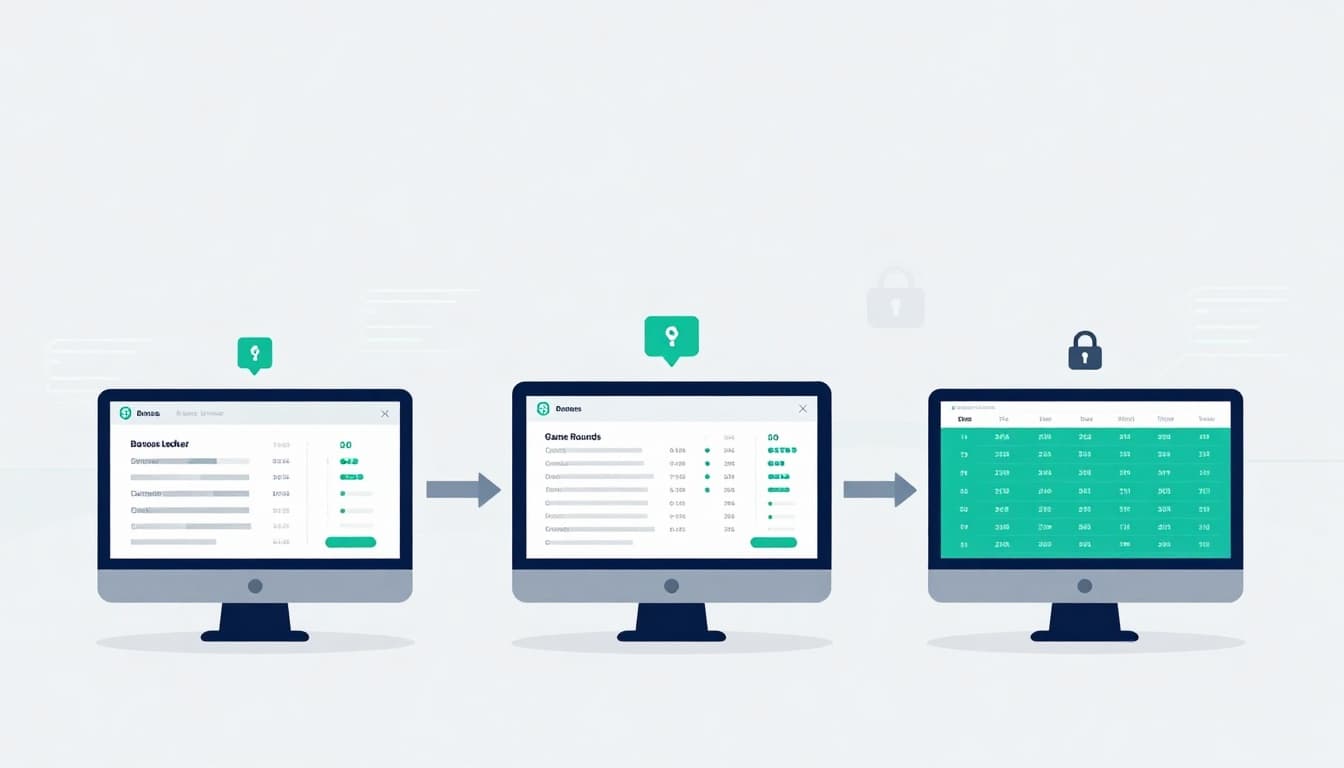
5) Reconcile three ledgers: bonus, wagering, and game rounds
Summary: Tie the bonus balance to wagering progress and underlying gameplay records.
Why it’s valuable: Reconciliation proves integrity, not just good intentions.
Who it’s for: Operators using multiple vendors (PAM, sportsbook, casino).
How to start: Match by player ID, timestamp window, and transaction IDs.
Example: Confirm a $50 bonus credit, its wagering progress, and each contributing round/bet.
6) Test rule enforcement with “try to break it” scenarios
Summary: Attempt prohibited actions and confirm controls stop them.
Why it’s valuable: A control that only works in normal paths isn’t a control.
Who it’s for: Teams relying on vendor configuration defaults.
How to start: Run scripted tests for max bet breaches, excluded games, partial cashout, and mid-bonus withdrawals.
Example: Player exceeds max bet during wagering, confirm auto-void or restriction behaves as terms state.
7) Check eligibility and fraud controls around bonus abuse
Summary: Verify how you prevent multi-accounting and promo farming.
Why it’s valuable: Weak controls create financial loss and compliance exposure.
Who it’s for: Operators with aggressive acquisition promos.
How to start: Review device fingerprinting, shared payment methods, and identity reuse rules.
Related internal guide: Pair this with an iGaming KYC workflow audit checklist so bonus controls and onboarding controls don’t contradict each other.
8) Confirm AML and safer gambling flags don’t get bypassed
Summary: Ensure risk triggers still fire when play is bonus-funded.
Why it’s valuable: Bonus activity can mask spend patterns and rapid cycling.
Who it’s for: Compliance and risk teams managing thresholds and alerts.
How to start: Validate alert logic, case notes, and evidence retention on bonus-heavy accounts.
External context: Use this overview on AML and sanctions compliance in iGaming to sanity-check your screening and record-keeping expectations.
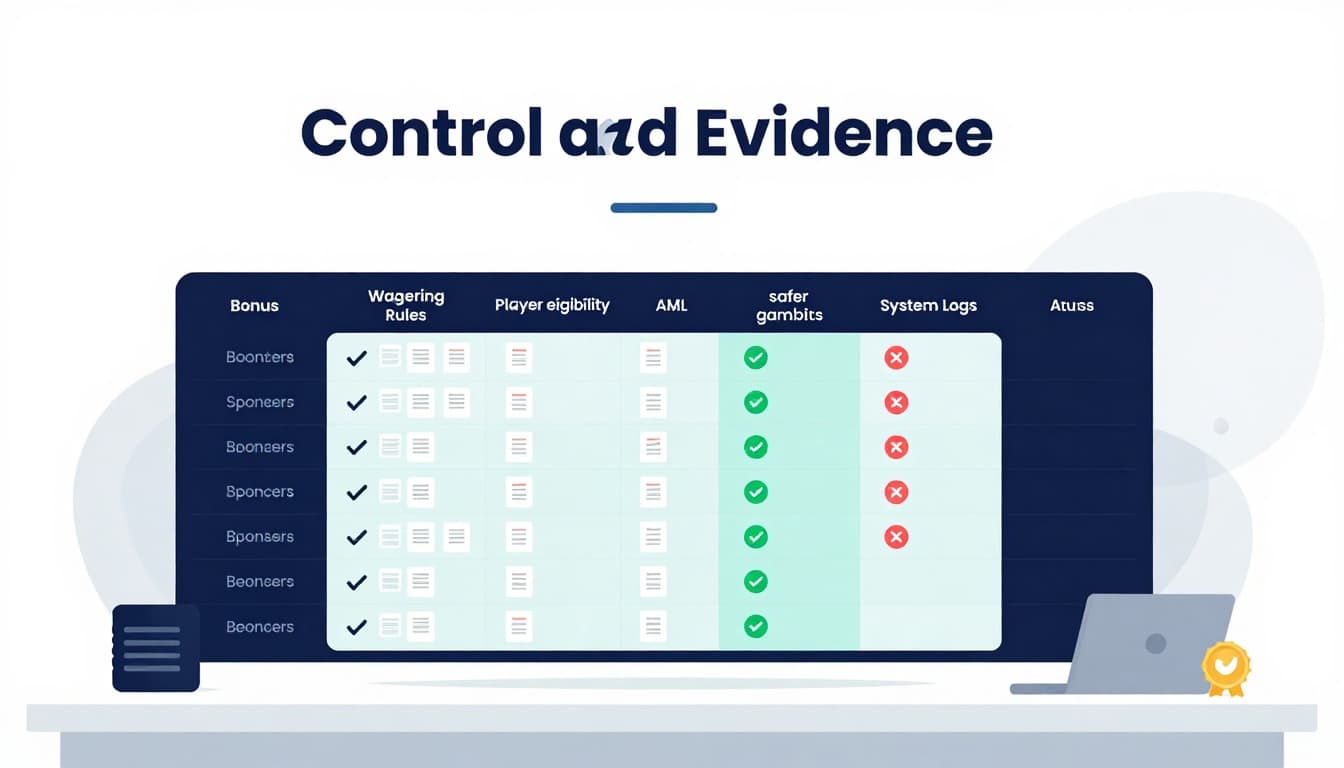
9) Build an evidence pack that a stranger can follow
Summary: Assemble documents, logs, and sign-offs into a clean audit trail.
Why it’s valuable: The best control is useless if you can’t prove it.
Who it’s for: Operators preparing for regulator review, banking due diligence, or platform audits.
How to start: Use an index (what, where, owner, date), then attach screenshots, exports, and approvals.
Internal support: This iGaming license compliance documentation guide is useful when you need to standardize what “good evidence” looks like.
10) Track exceptions to closure (with owners and deadlines)
Summary: Convert findings into remediation tasks with measurable outcomes.
Why it’s valuable: Reviewers judge your response as much as the gap.
Who it’s for: Any operator trying to avoid repeat findings.
How to start: Log issue, impact, root cause, fix, retest evidence, and sign-off.
Example: “Excluded game list not applied on Provider B”, patch config, rerun tests, attach results.
Quick tool stack to support your audit (simple, not fancy)
| Tool or platform | Best for | Starting cost | Key benefit |
|---|---|---|---|
| Notion or Confluence | Terms library and evidence index | Free plan available | Versioned documentation and approvals |
| Jira (or similar) | Remediation tracking | Free plan available | Owners, deadlines, audit-ready history |
| Google Sheets | Sampling and control matrix | Free | Fast mapping and review notes |
| Secure file storage (vendor or cloud) | Evidence retention | Varies | Controlled access and retrieval speed |
For broader compliance program context, this guide on how online operators can achieve gambling compliance is a solid reference point for tying KYC, AML, and governance together.
How to choose what to fix first when you’re under review
Use a simple triage lens:
- Player impact: Does it change outcomes (wins, withdrawals, eligibility)?
- Regulatory risk: Would this look like unfair terms or weak controls?
- Repeatability: Is the issue systemic (config template) or one-off?
- Evidence gap: Is the control fine but proof is missing?
A good rule: fix anything that changes player treatment first, then close evidence and process gaps.
Conclusion
When you run promotions at scale, bonus wagering is like a set of train tracks. If even one switch is misaligned, the whole system can go off course fast.
A strong bonus wagering compliance audit isn’t about passing a single review. It’s about turning bonus terms, system rules, and audit trails into routine operations your team can repeat every quarter. If you build the mapping, reconciliation, and evidence pack now, the next review becomes a managed process, not a panic.

Adeyemi Adetilewa leads the editorial direction at IdeasPlusBusiness.com. He has driven over 10M+ content views through strategic content marketing, with work trusted and published by platforms including HackerNoon, HuffPost, Addicted2Success, and others.