
Most products don’t lose users because they’re “bad.” They lose users because the experience feels like a bucket with tiny holes: a confusing signup, a slow first win, a weak reason to come back.
That’s where user lifecycle management earns its keep. For startup founders, marketers, and small business owners, it’s the practical system for turning attention into action, and action into loyalty, without guesswork.
This guide gives you 10 business ideas you can implement to improve engagement at every stage, plus a simple way to choose what to fix first.
What user lifecycle management really is (and why it pays off)
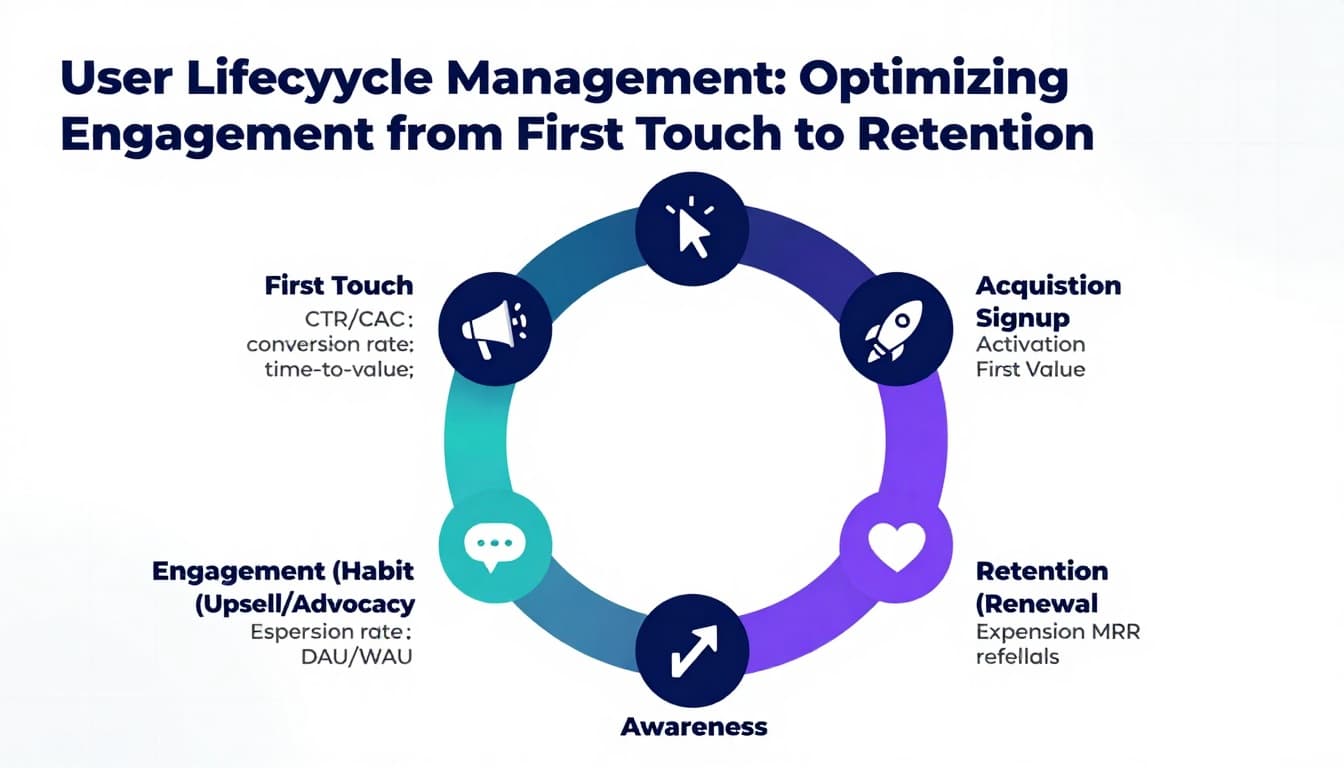
User lifecycle management is the process of guiding people from their first encounter with your brand to long-term usage, renewals, and upgrades. Think of it like coaching, not chasing. You’re helping users reach the next win, step by step.
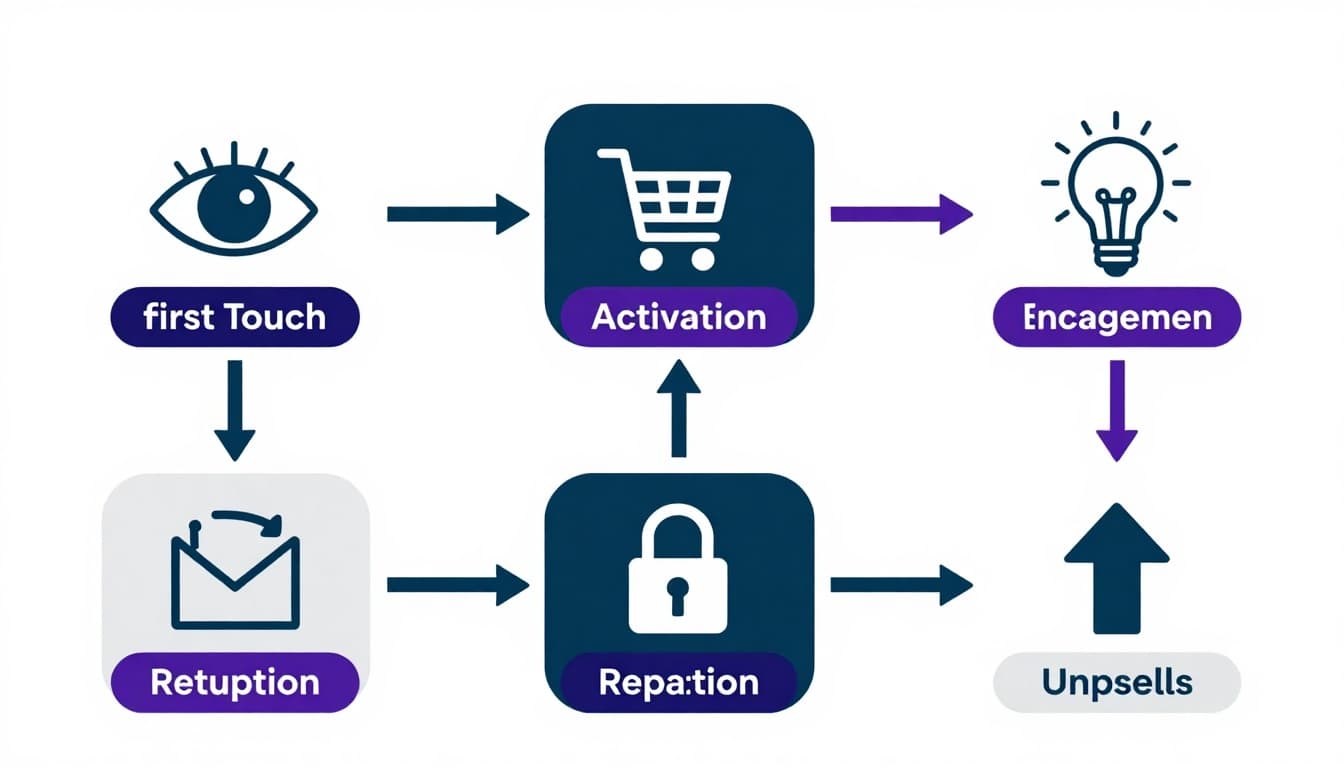
A clean lifecycle model usually looks like: First Touch, Acquisition, Activation, Engagement, Retention, Expansion. If you want a clear breakdown of lifecycle stages and what they mean, see Amplitude’s customer lifecycle explanation.
To keep it measurable, tie each stage to a small set of metrics. If you’re building a SaaS product, start with essential SaaS metrics for growth so you don’t confuse “activity” with progress.
10 business ideas to improve engagement at every lifecycle stage
1) “First-touch” content that answers one urgent question
Summary: Build one page or asset that solves a high-intent problem fast.
Why it’s valuable:
- Earns trust before a demo or trial
- Pre-qualifies the right users
Who it’s for: Content-led SaaS, agencies, pro services.
How to start: Write one “do this, not that” guide tied to your core feature.
Tools: Webflow, WordPress, Ahrefs, Google Search Console.
Example: A bookkeeping app publishes a checklist for month-end close.
2) Signup friction audit (reduce the “I’ll do it later” moment)
Summary: Remove every extra field, click, and surprise from signup.
Why it’s valuable:
- Higher conversion with the same traffic
- Cleaner attribution for campaigns
Who it’s for: Any product with a signup wall.
How to start: Watch 10 session recordings, list drop-off points, fix the top 2.
Tools: Hotjar, Microsoft Clarity, GA4.
Example: Swap “confirm email first” for “confirm after first action.”
3) A “first value” onboarding path (one job, one win)
Summary: Design onboarding around the first outcome, not the full product tour.
Why it’s valuable:
- Shortens time-to-value
- Makes the product feel easier than it is
Who it’s for: Freemium, trials, product-led growth.
How to start: Define the one action that predicts retention, then guide users to it.
Tools: Userpilot, Appcues, Pendo.
Example: A CRM pushes users to import contacts before showing automations.
4) Triggered nudges based on behavior (not time)
Summary: Message users based on what they did, not what day it is.
Why it’s valuable:
- Feels personal without manual work
- Prevents early silent churn
Who it’s for: Products with multiple use cases.
How to start: Pick 3 key behaviors (created X, invited Y, used Z) and trigger tips.
Tools: Braze, Customer.io (learn the lifecycle approach in Braze’s guide).
Example: If a user creates a project but never assigns tasks, send a 30-second how-to.
5) “Habit loops” that reward the next best action
Summary: Give users a reason to return with light progress cues and rewards.
Why it’s valuable:
- Builds routine usage
- Increases feature adoption naturally
Who it’s for: Tools used weekly or daily (finance, ops, marketing).
How to start: Add a simple progress meter tied to outcomes (not badges for clicks).
Tools: Mixpanel, Amplitude, PostHog.
Example: A budgeting app celebrates “3 days tracked” and suggests the next category.
6) Cancellation intercept offers that aren’t desperate
Summary: When users try to cancel, offer a smarter path: pause, downgrade, or help.
Why it’s valuable:
- Saves revenue without pressure
- Teaches you the real churn drivers
Who it’s for: Subscription businesses.
How to start: Add a 2-question exit survey plus a “pause for 30 days” option.
Tools: Stripe Billing, Chargebee, Typeform.
Example: Pair this with insights from why users cancel subscriptions.
7) Customer health scoring that a small team can actually use
Summary: Create a simple health score so you know who needs help this week.
Why it’s valuable:
- Focuses support and success efforts
- Prevents “surprise” churn
Who it’s for: B2B SaaS, agencies with retainers.
How to start: Combine 3 signals: product usage, support tickets, and billing risk.
Tools: HubSpot, Gainsight (for larger teams), Google Sheets (to start).
Example: A user’s score drops after 14 days inactive, the CS team reaches out.
8) A “welcome to the community” play for advocacy
Summary: Turn happy users into visible users, then into referrers.
Why it’s valuable:
- Lowers acquisition costs over time
- Builds social proof that converts
Who it’s for: Creator tools, B2B SaaS, e-commerce subscriptions.
How to start: Invite new customers to one community touchpoint within 7 days.
Tools: Circle, Slack, Discord.
Example: A design tool features customer templates in a monthly roundup.
9) Expansion offers tied to usage, not discounts
Summary: Upsell only when the user is already winning.
Why it’s valuable:
- Higher conversion with less pushback
- Better fit between plan and value
Who it’s for: Tiered SaaS, add-on models.
How to start: Trigger upgrades when users hit a limit that blocks outcomes.
Tools: Stripe, ProfitWell (if applicable), in-app modals.
Example: “You’ve hit 80% of your automation runs, add 5,000 more to keep campaigns live.”
10) Lifecycle automation with clean integrations (so data stays honest)
Summary: Connect product events, CRM, billing, and support so teams act on the same truth.
Why it’s valuable:
- Fewer manual handoffs
- Better segmentation and reporting
Who it’s for: Teams juggling many tools.
How to start: Map where lifecycle data lives, then connect only what you’ll use weekly.
Tools: Zapier, Make, Segment.
Example: Follow best practices for SaaS integration to avoid messy syncs.
Quick comparison: tools that support lifecycle work
| Tool/platform | Best for | Starting cost | Key benefit |
|---|---|---|---|
| Google Analytics (GA4) | Acquisition tracking | Free | Clear funnel visibility |
| HubSpot | Lifecycle email + CRM basics | Free tools and paid plans | Sales and marketing alignment |
| Intercom | In-app support and onboarding | Paid plans | Faster user help in context |
| Braze | Multi-channel lifecycle messaging | Paid plans | Strong segmentation and orchestration |
| Zapier | Automation between tools | Free tier and paid plans | Faster workflows without code |
How to choose the right lifecycle idea to start with
Use this short checklist before you build anything new:
- Pick your bottleneck: Is it signup, first value, or retention? Only pick one.
- Choose one metric: Conversion rate, time-to-value, churn, or expansion revenue.
- Start with the cheapest fix: Copy, UX, and messaging often beat new features.
- Talk to five users: One call can save weeks of guessing.
- Make it measurable: If you can’t measure it, you can’t improve it.
- Set a two-week test window: Ship, measure, then decide.
If your lifecycle touches access and permissions (common in larger teams), it helps to understand the IT angle of ULM too, see BetterCloud’s overview of user lifecycle management.
A simple lifecycle scorecard (set it up this week)
You don’t need a complex dashboard to start. Track one “primary” metric and one “watch-out” metric per stage:
| Lifecycle stage | Primary metric | Watch-out metric |
|---|---|---|
| First Touch | CTR or qualified visits | Bounce rate |
| Acquisition | Signup conversion | Cost per signup |
| Activation | Time-to-first value | Onboarding drop-off |
| Engagement | Weekly active users | Feature abandonment |
| Retention | Churn rate | Support backlog |
| Expansion | Expansion MRR | Downgrades |
Conclusion
User growth isn’t a single tactic, it’s a chain. When one link breaks, the whole experience weakens. The smartest teams treat user lifecycle management like routine maintenance: small, consistent improvements that keep users moving toward value.
Pick one stage, ship one change, measure for two weeks, then repeat. Which stage of your lifecycle feels like the leakiest bucket right now?

Adeyemi Adetilewa leads the editorial direction at IdeasPlusBusiness.com. He has driven over 10M+ content views through strategic content marketing, with work trusted and published by platforms including HackerNoon, HuffPost, Addicted2Success, and others.