
If you’re building a product that touches money, health data, kids, ads, or enterprise buyers, compliance stops being a “later” problem fast. One missed requirement can feel like a tiny paper cut until it turns into a lawsuit, a frozen payout account, or a failed enterprise security review.
This guide is built for founders and operators who need to hire compliance analyst talent for the first time, without hiring the wrong person or wasting a quarter on confusion. You’ll get a practical skills test, a structured interview scorecard, and a clear 30-day onboarding plan that turns a new hire into a real operating system.
What a compliance analyst should own and what they shouldn’t
Think of your first compliance analyst like a smoke detector, not the fire department. They should spot risk early, document it clearly, and help teams fix it before it spreads.
A strong “first hire” scope usually includes:
- Compliance intake and triage: capturing requests, identifying the applicable rule or standard, and logging decisions.
- Policy and procedure drafting: simple, readable policies that match how your company works.
- Control evidence and audits: collecting proof, organizing folders, and keeping timelines realistic.
- Training support: helping you teach sales, support, and engineering what “good” looks like.
What they shouldn’t own alone (yet):
- Final legal interpretation (that’s counsel).
- Full security engineering or privacy engineering.
- Enterprise GRC tool implementation, unless they’ve done it before, and you truly need it now.
If you’re unsure where to draw the line, write it down anyway. Clarity beats “we’ll figure it out.”
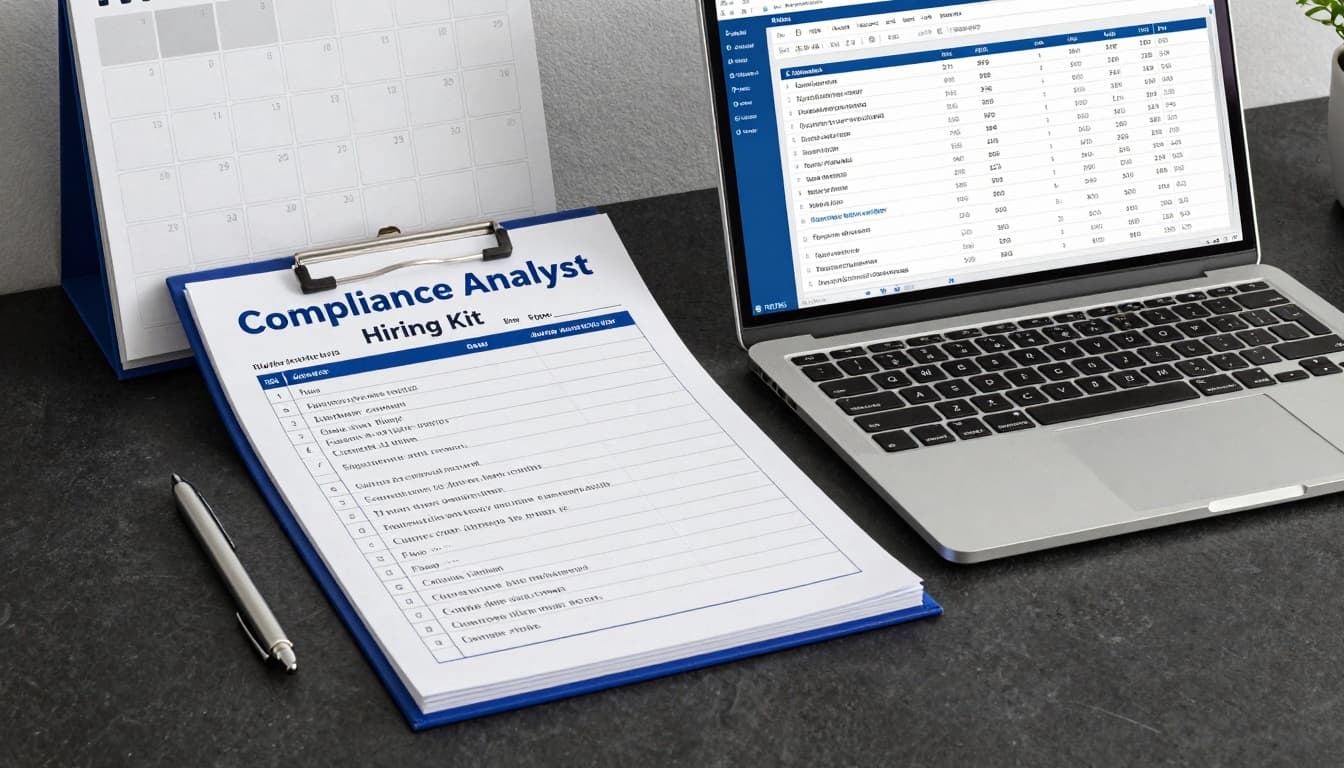
A one-page success profile before you start interviews
Before you post a job, build a one-page success profile. It keeps you from hiring someone great on paper but wrong for your actual risk. Include:
Your environment: fintech, healthcare, marketplace, B2B SaaS, adtech, crypto, or “moving into regulated territory.”
Top outcomes (next 6 months):
- Reduce compliance cycle time for product launches.
- Pass a customer security review with clear evidence.
- Build hint-free documentation so decisions are repeatable.
Must-have skills:
- Writing (policies, incident notes, risk summaries).
- Stakeholder handling (polite pushback, clear escalation).
- Evidence habits (folders, versioning, audit trails).
Nice-to-have: experience with SOC 2, ISO 27001, AML, privacy requests, or vendor risk, based on your industry.
The compliance analyst skills test (90 minutes, based on real work)
A skills test should feel like the job. Not trivia. Not “name 20 regulations.” Give a small scenario, a few artifacts, and ask for clear outputs.
1. Test scenario (send as a PDF or doc)
“You’re joining a startup that sells to small businesses. The product connects to bank accounts (read-only) and generates monthly reports. A customer asks for SOC 2, and the product wants to ship a new data export feature next week.”
Provide:
- A mock data flow diagram (simple).
- A draft export spec (half page).
- Two short policy snippets (one good, one messy).
- A pretend customer security questionnaire with 10 questions.
2. Candidate deliverables
Ask for four items:
- Risk notes (one page max): top 5 risks, written for a founder.
- Control checklist: 8 to 12 controls you’d want in place before claiming readiness for SOC 2 style questions.
- One rewritten policy paragraph: fix the messy snippet so it’s readable and enforceable.
- Customer response: answer 3 questionnaire questions using the provided info, calling out any gaps.
3. Scoring rubric (simple and telling)
Score each area 1 to 5:
- Clarity: Could a non-expert act on it?
- Judgment: Did they flag real risks without panic?
- Practicality: Did they propose controls that a small team can do?
- Evidence mindset: did they think in “prove it” terms?
- Writing quality: short sentences, clear definitions, no word salad.
Tip: tell candidates they can use bullet points. You’re testing thinking, not formatting.

An interview scorecard that avoids “vibes hiring.”
Unstructured interviews reward confidence and familiarity. Compliance hiring needs the opposite: consistent judgment under uncertainty.
Use a scorecard and keep it the same for every candidate.
Core competencies to score (with suggested weights)
| Competency | What “good” looks like | Weight |
|---|---|---|
| Regulatory reasoning | Can map a situation to requirements, then explain limits | 20% |
| Writing and documentation | Produces crisp policies, notes, and decisions | 20% |
| Risk prioritization | Separates “must fix” from “later,” explains tradeoffs | 20% |
| Stakeholder management | Pushes back calmly, escalates cleanly, builds trust | 20% |
| Operational discipline | Tracks tasks, evidence, timelines, and owners | 20% |
Score each 1 to 5, then multiply by weight. Require written notes from each interviewer, even brief.
Five interview questions that reveal real ability
Ask questions that force the candidate to show how they think:
- “Tell me about a time you disagreed with a product on risk. What happened?”
- “What evidence would you collect to support a compliance claim?”
- “A customer asks for a policy you don’t have. What do you do in 48 hours?”
- “What’s your process for handling a potential incident report?”
- “What’s a compliance metric you’d track weekly, and why?”
For more question ideas, this list of compliance analyst interview questions can help you fill gaps without repeating yourself.
If you also run informal chats with cross-functional leads, treat them like real interviews. Casual settings can still create bias, so borrow a few tactics from this guide on preparing for coffee interview questions.
Background checks for a risk role (don’t skip the basics)
Compliance roles often touch sensitive data, vendor approvals, and customer claims. Do the standard checks and match them to the role’s access level.
A practical starting point is identity, employment verification, and references, plus any checks your industry expects. Here’s a useful breakdown of the importance of pre-employment screening when hiring roles tied to trust and controls.

The 30-day plan: Turn a new hire into a working system
The first month should produce artifacts, not just meetings.
Days 1 to 7: Map reality
- Meet leads in product, engineering, support, sales, and finance.
- Inventory what exists: policies, vendor list, data map, and incident history.
- Create a single “compliance intake” channel (email or ticket queue) with clear tags.
Output by day 7: a one-page risk register draft and a list of the top 10 open items.
Days 8 to 14: Pick the first two wins
Choose two wins that reduce risk and reduce chaos, like:
- A lightweight vendor risk checklist.
- A standard customer security questionnaire response pack.
- A simple policy set (access control, data retention, incident response).
Output by day 14: versioned policies in a shared folder, plus owners for each control.
Days 15 to 21: Build an evidence habit
- Set up an evidence library with naming rules (Control, Date, Owner).
- Run one “mini-audit” internally: can you prove access reviews, onboarding, and backups?
Output by day 21: a working evidence index and a short gap list.
Days 22 to 30: Make it repeatable
- Create a monthly compliance calendar (reviews, training, vendor checks).
- Draft a simple KPI snapshot: open risks, overdue evidence, and customer requests.
Output by day 30: a repeatable cadence the team can live with.
A lightweight tool stack for early-stage compliance
You don’t need fancy software to start, but you do need consistency.
- Tickets (Jira, Linear, or Help Scout): compliance requests should be trackable.
- Docs (Google Drive or Notion): policies, decisions, and evidence in one place.
- Automation for reminders and evidence collection. If you want options, this list of top AI automation tools for business can help you set up nudges without chasing people all month.
Conclusion
Your first compliance hire sets the tone for how your company handles trust. A short skills test shows how candidates think, a scorecard keeps your team honest, and a 30-day plan turns good intent into repeatable work.
If you’re ready to hire compliance analyst talent, start by defining outcomes, then make every step measurable, practical, and easy to repeat.

Adeyemi Adetilewa leads the editorial direction at IdeasPlusBusiness.com. He has driven over 10M+ content views through strategic content marketing, with work trusted and published by platforms including HackerNoon, HuffPost, Addicted2Success, and others.